I began this expedition in 2018 as a way of squaring my art circle which had begun in 1967 and died an ignominious death in 1968 due to massive cultural dislocation. Yorkshire was barely out of the 1950s while Brighton was spaced out and dropped out and jangling through its hippie flower-power summer of luuuurve phase. We had more hair than skirt length, everyone slept on other people’s floors, nothing had a lock on it, and meals seemed to come from nowhere. Not surprisingly, my brain fell over and refused to function so I went back to Yorkshire, straightened myself out and became a scientist.
So now here I am, on the edge of finally getting the degree* I began a lifetime ago and do I regret this gap year of all gap years? Not in the least because imagination and creativity draw on information and ways of thinking stored away in an unconscious reservoir and after all this time, mine has more books and ideas in it than Matt Haig’s Midnight Library. The other reasons are all about maturity, resilience, resources, and the confidence that comes with a greater familiarity with my own identity.
Recently, I’ve been revisiting my digital apps, in particular Flamepainter by Escapemotions which is a feisty piece of kit that is more like herding fire lizards than actually painting. I have both the iPad version and the desktop app and I use them to prompt free-flowing movements in images I really can’t control very well. This physical painting is based on one of those expeditions.
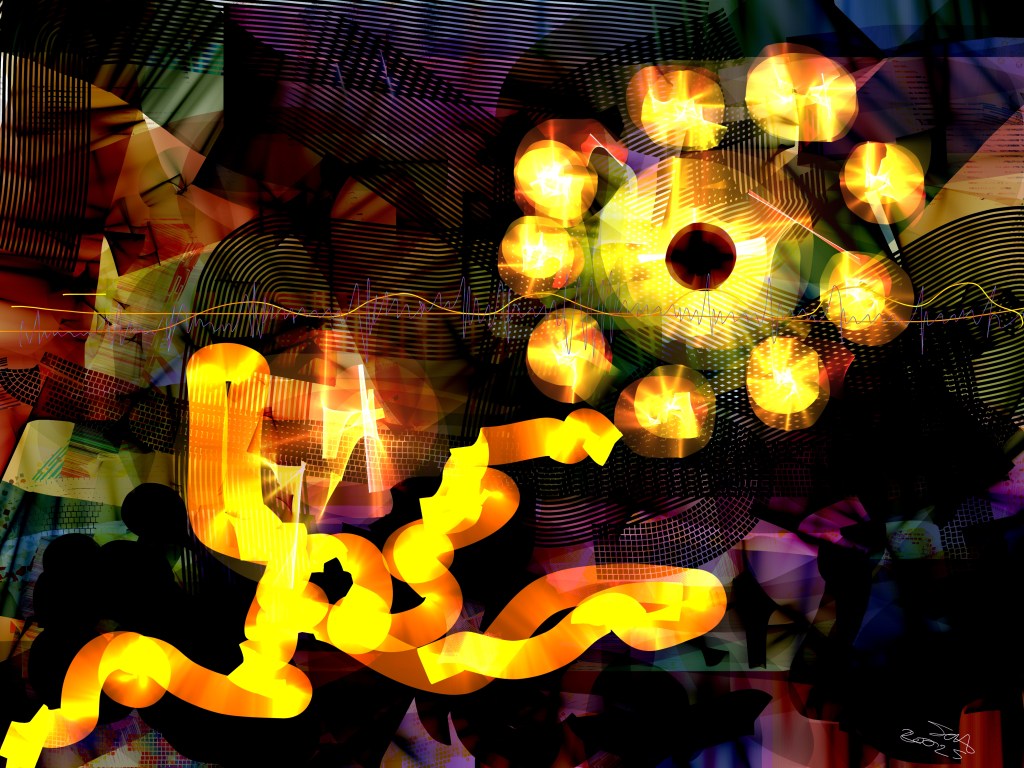
There are several layers here, some of them textural, some trails of light, others curtains of mixed colours; all of them chosen, mixed, adjusted, faded, modified by me; and my task is to address this using physical media.
But just as I do with photographic reference material, I will be making a painting not of the digital image but about it. And right now I’m in exactly the same place as I would be with a photo of a landscape – no idea where to start or how it’s all going to work and that’s the thrill of it.
Here’s the first image, rather oddly rendered after a session on adjusting our cameras to photograph artwork which clearly I didn’t get the hang of. And whatever the setting was, it seems to have turned a flat surface into something 3D and quite ghostly, which could become another strand in this narrative.
The support is black A1 card, the marks are white charcoal, and the texture is an adhesive tape that looks as though it should be wrapped round a plaster cast on someone’s leg. This is the basic structure which I’ve set in place with a coat of varnish, and I have my eye on transparency sheets for some as yet unspecified purpose.
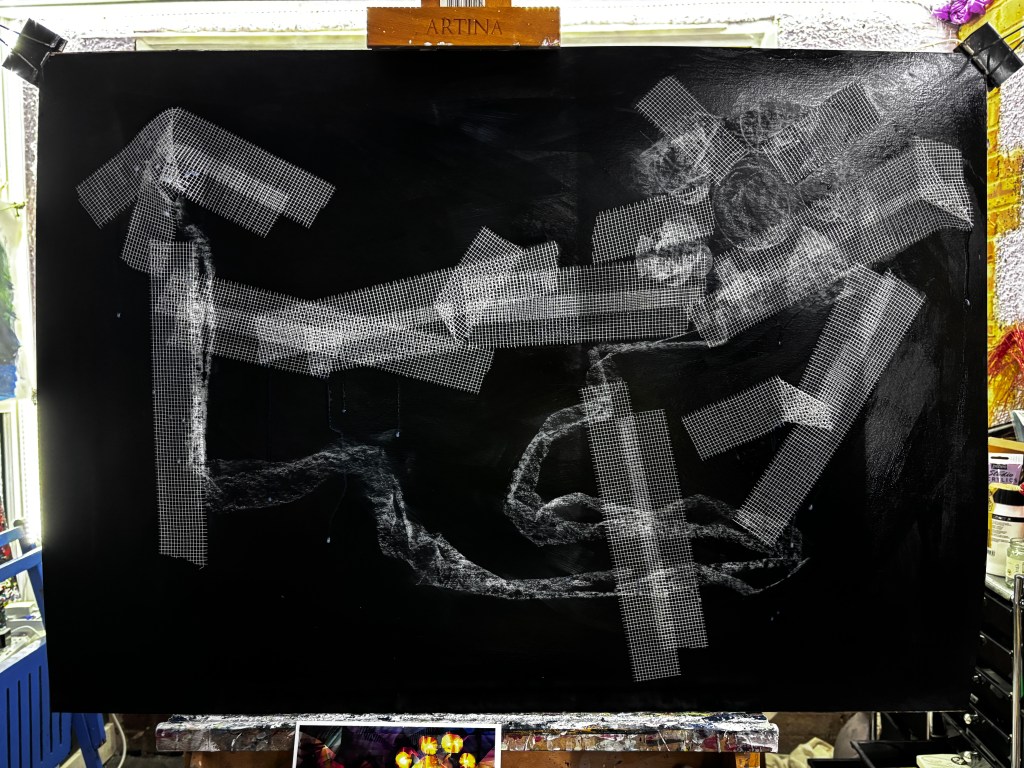
The camera was set on ‘Live’ so this, above, is what ‘live’ looks like.

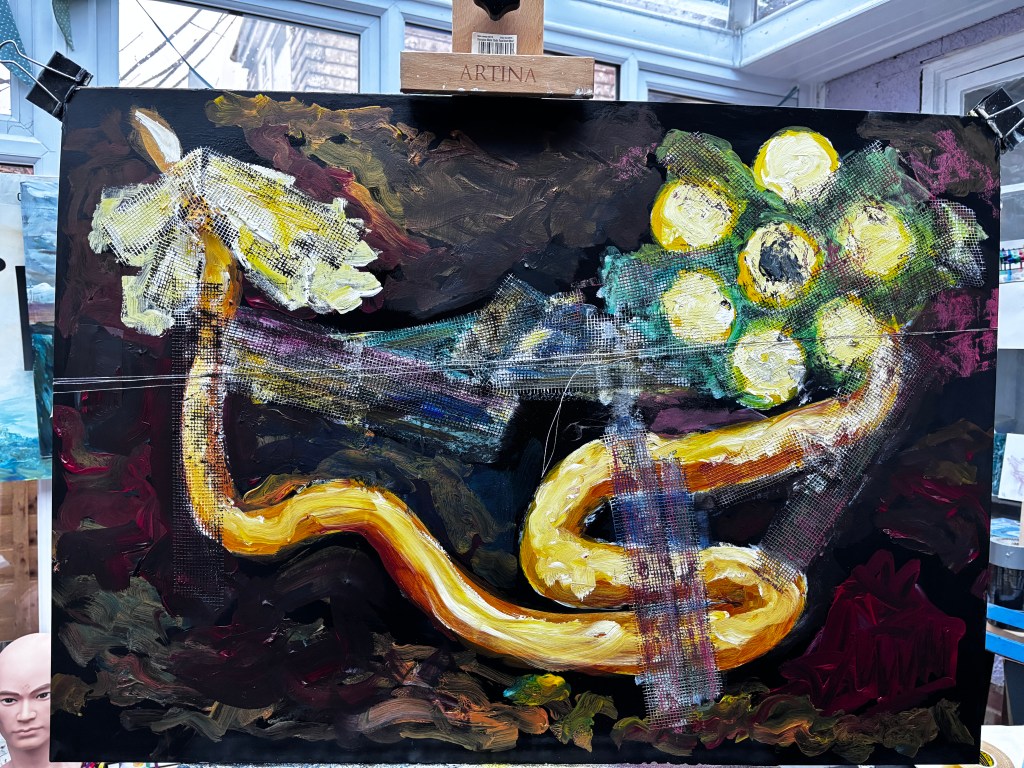
There’s a lot of colour on this now and it’s beginning to morph from a flower to something like the James Web Space Telescope. But it’s clearly not ours so I’m guessing we’re the ones under observation!
I’ve used acrylics, mainly, but the tape accepts soft pastel really well and this picks out the structure.
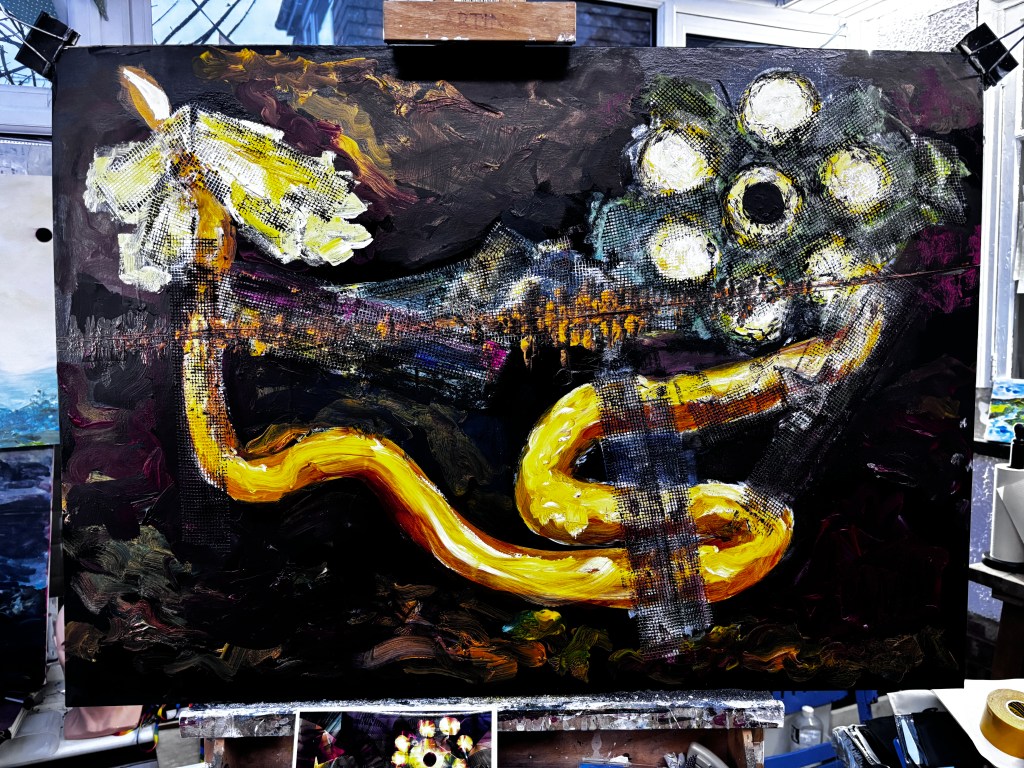
The central horizontal is a piece of thread from the roll of tape. With orange paint dabbed onto and through it, it becomes a wave form – or a city. I’m not sure which at the moment but both would be about structure and communication.
So at close of play today, I have a structure something like a satellite, probably in deep space, which is either sending or receiving communications, and possibly providing anchor points for some kind of habitat. I’m not entirely convinced by it at present but whatever else happens, it will in due course make a decent companion for the digital piece.
27th January. I’ve done a lot of looking at this – IRL and as photos at different stages and I think the problem I’m having is a lack of narrative. What is this? Where is it? What’s it doing there? How big is it – microscopic or megascopic? Could you crush it underfoot in your slippers or is it larger than the solar system? There’s something quite cartoonish about it at the moment and that may be to do with the pastels, or at least the lack of brush strokes, and this I can deal with.
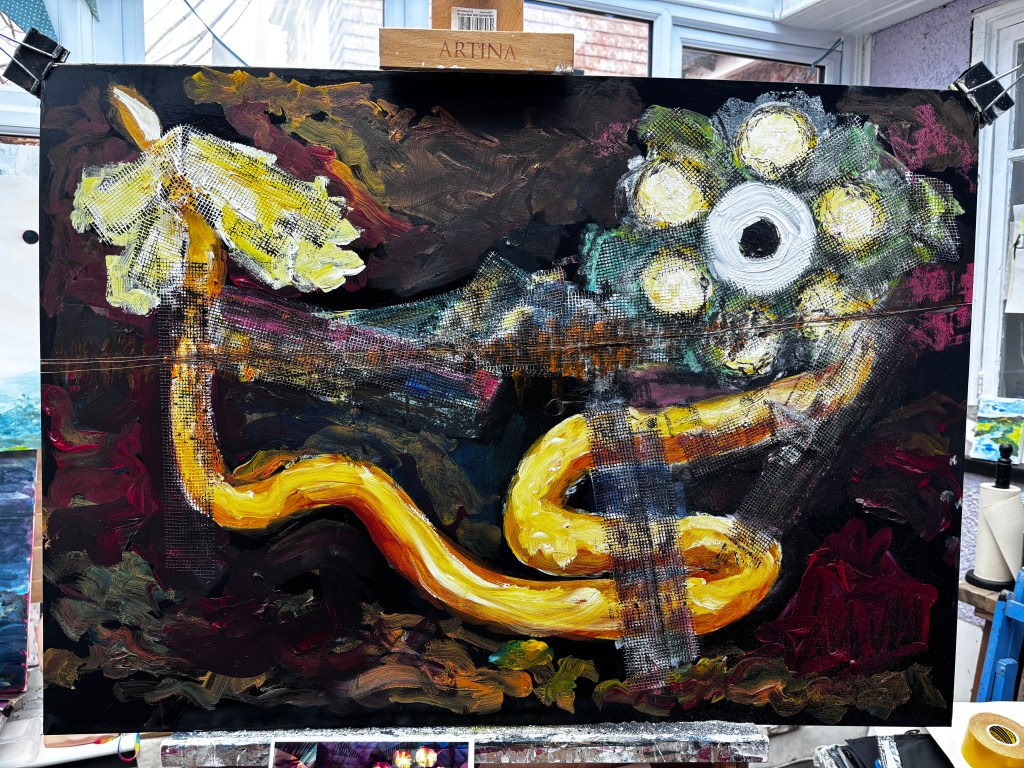
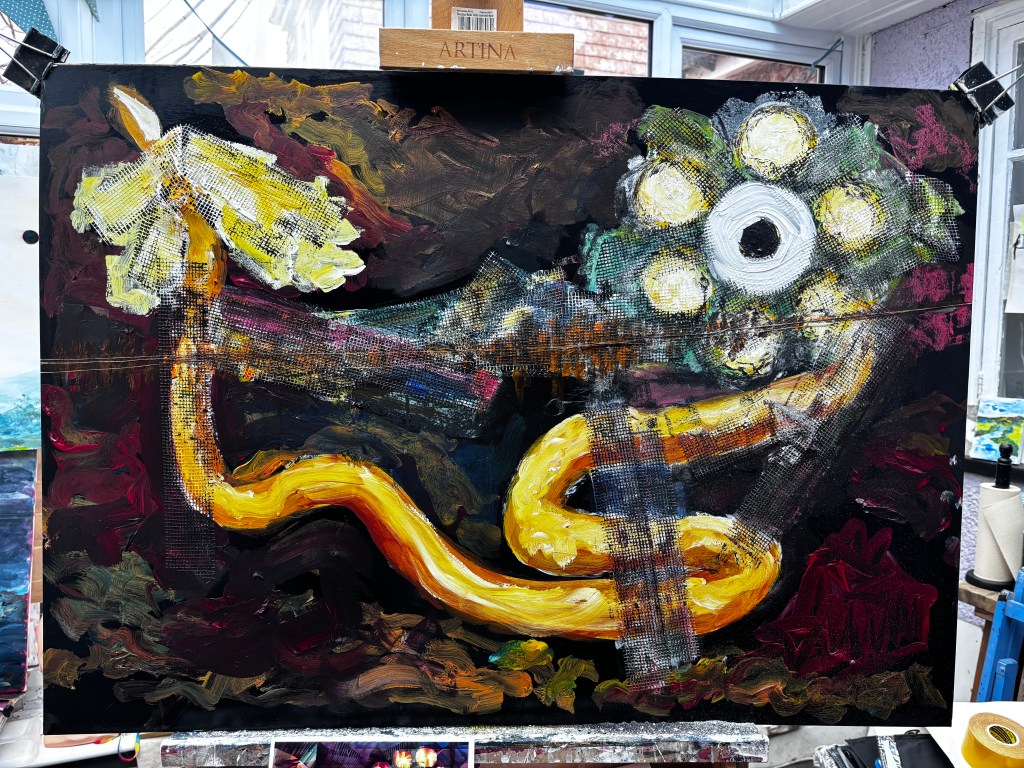
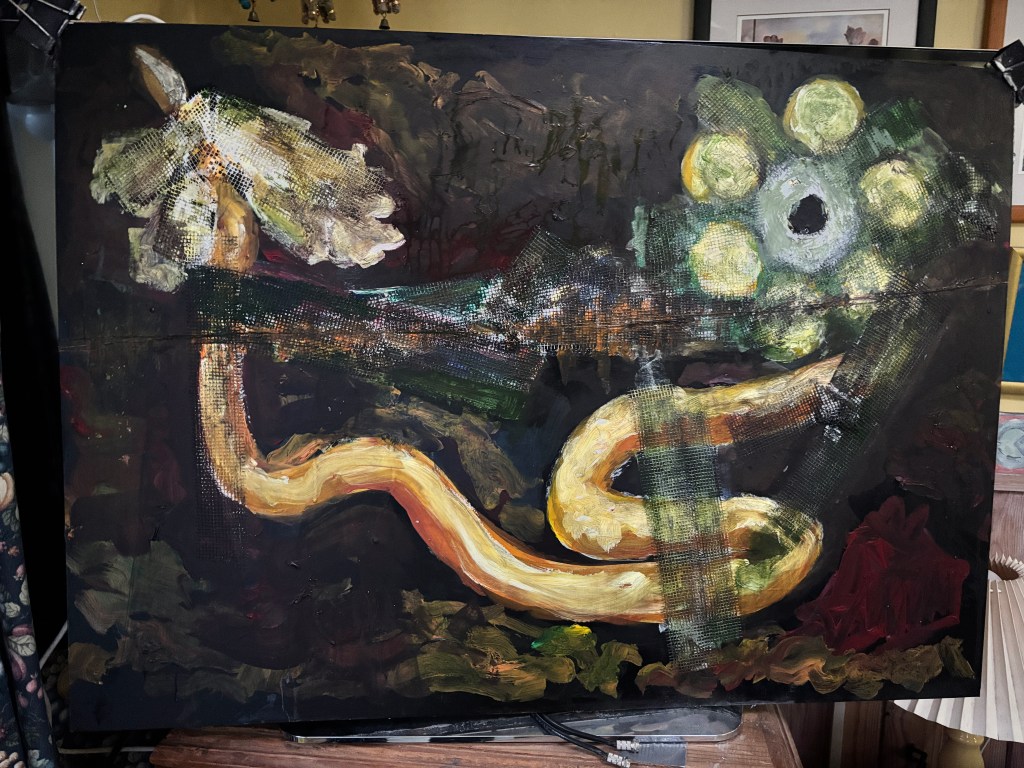
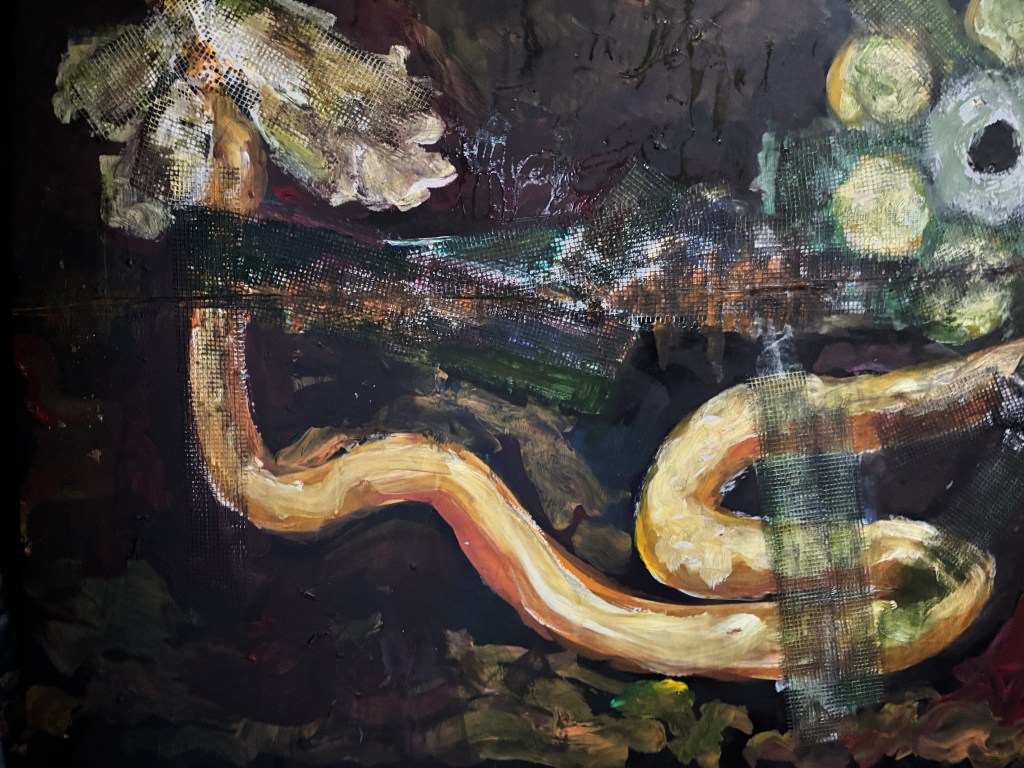
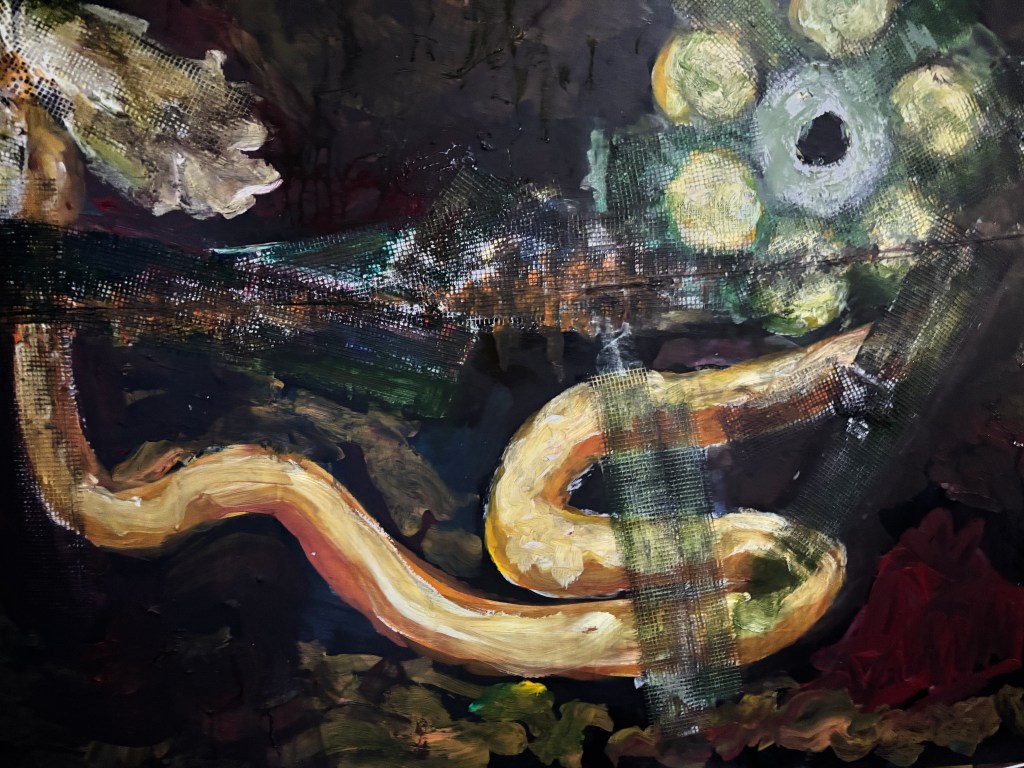
Reached peak reflection time so tomorrow’s photos will be better. The process won’t have changed though, and that includes scrubbing out the pastel, wiping the surface, then introducing dilute acrylic in dark shades to the whole. Once dry, or almost dry, I’ve scrubbed the textured areas with a rough cloth (usually one clogged with dry paint and rather scratchy) and worked my way round the painting pulling out newly textured areas where paint has seeped into cracks, leaving lines when the top surface is removed. The flower area is still quite wet so tends to smear rather than scratch. That’s a job for tomorrow.
28th January. The other issue I had yesterday and which is now resolved was the AR layer which seemed not to upload properly. I had a day’s learning experience with that, discovering that if I uploaded the video layer to the bridge in its 2D presentation, the video essentially clamps itself to the target image and can’t be moved. This is why I could hear but not see it and is the key to mapping AR tightly onto the target, something I’d been trying and failing to replicate using the 3D presentation. Uploading to the 3D presentation allows for independent editing of the position of the AR layer – bringing forward elements into the space between the target image and the viewer, for instance. This is simultaneously a small but huge discovery and may make a difference to how my outdoor and VR installations function.
This is the AR layer, the image made in Flamepainter, the animation in PhotoDirector. Audio is via Epidemic Sound, edited in PowerDirector.
Now titled Message, the image has become a deep space telescope, which may or may not be ours and which is sending (or receiving) a communication. Let’s imagine that for a moment. The AR includes a 3D layer.
As to the physical painting here, I’m toying with the idea of fading it into deep space with layers of dark wash, using photography to pull it out in the other direction in a video.
I really should have anticipated the difficulty of photographing black, not least because I’m so familiar with it but also because it was discussed in an OCA session with a professional photographer a couple of days ago and, beyond finding lights to position at 30 degrees and card to somehow deploy opposite this, there seems to be no real solution beyond post-production.
The best are the ones taken from a distance but which can be enlarged on-screen.
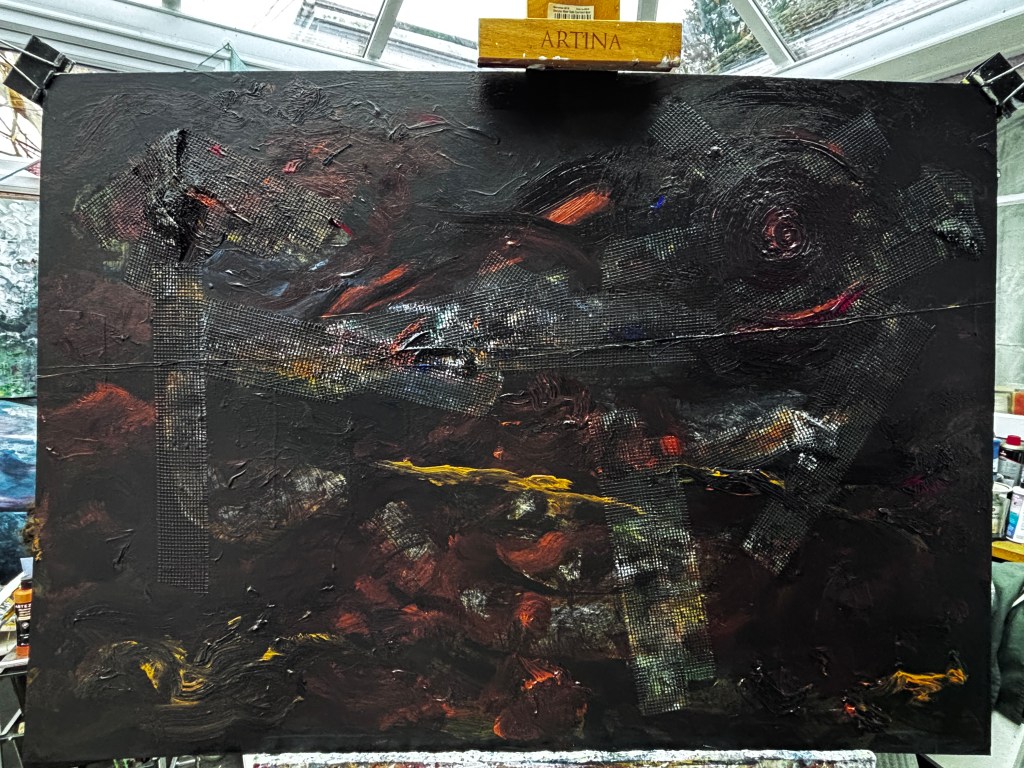
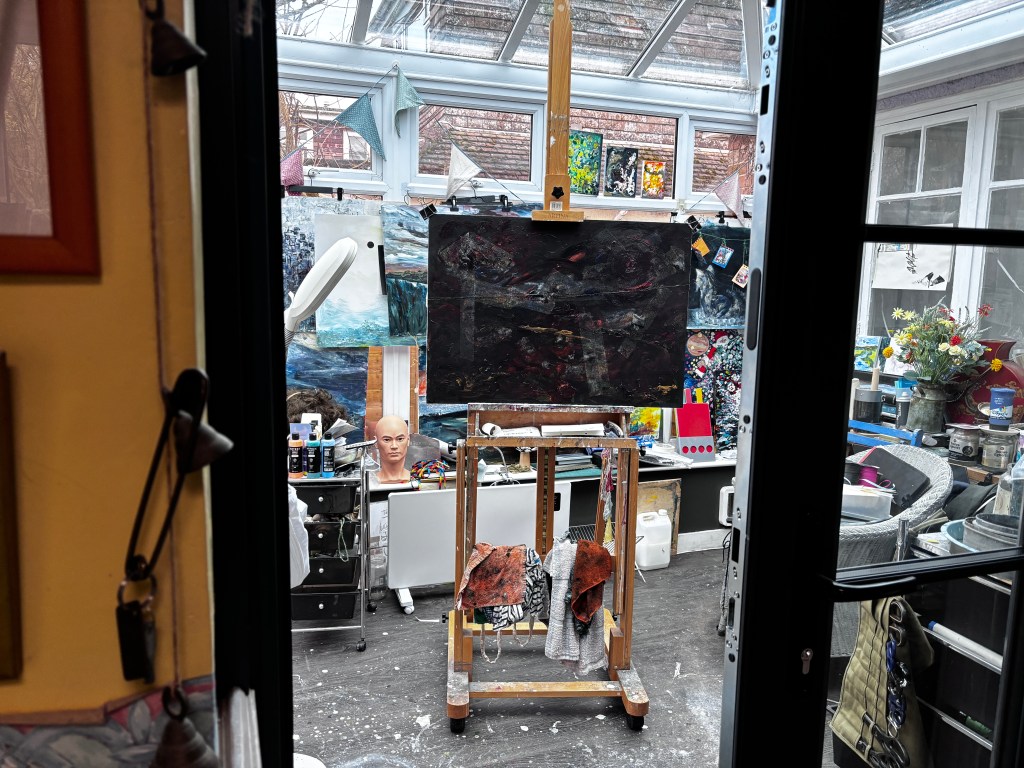
Yes, that is my studio and the parts you can’t see are no less chaotic. Thank you.
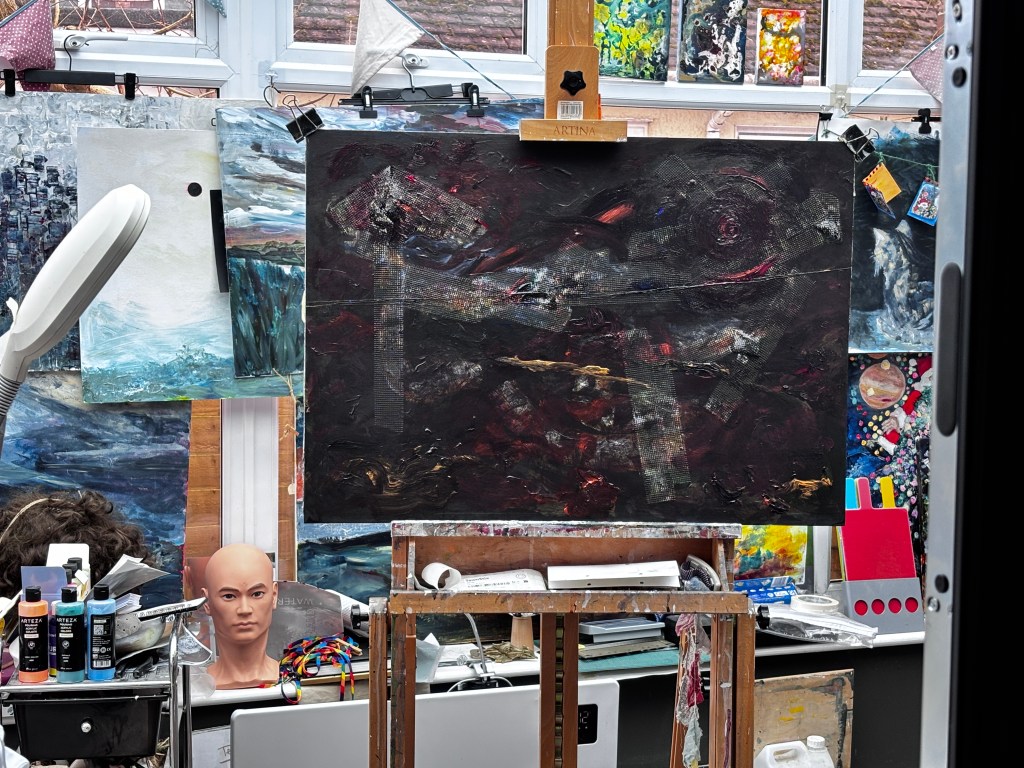
None of these is wholly satisfactory but the one taken at the greatest distance is closer to the reality.
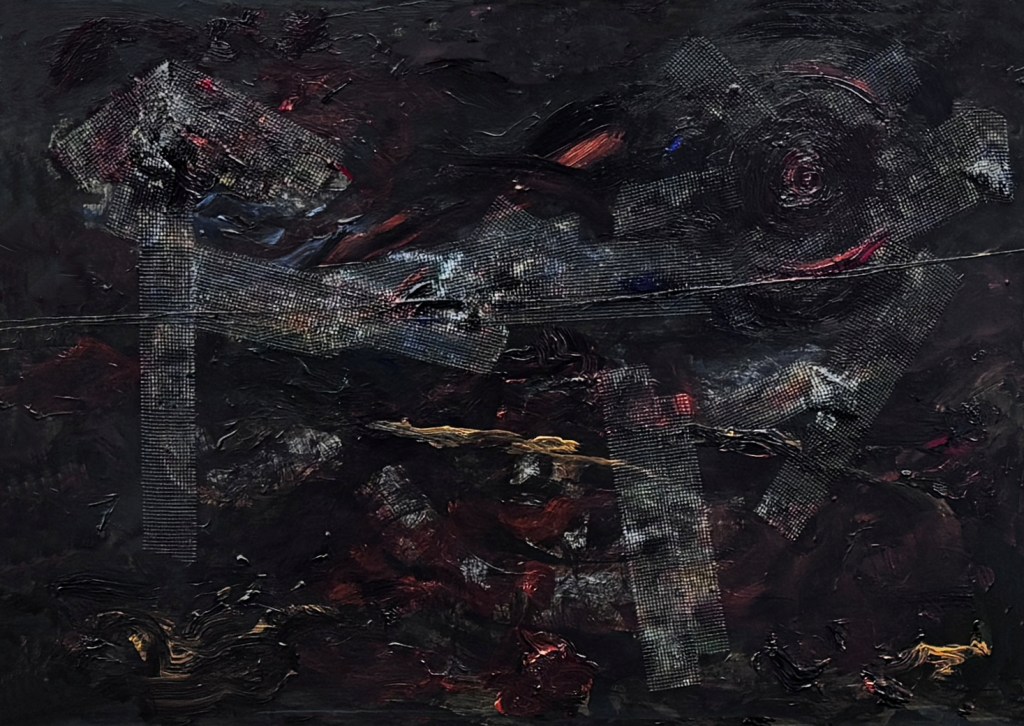
Cropped in Paintshop Pro. No other adjustments.
The next series of photos follows a ripping session whereby I pulled off sections of the architects’ tape leaving matte black patches where the surface of the black card was also ripped off, thereby dismantling the original structure. The result now puts me in mind of the wreckage of a space station which is probably the result of bingeing **The Expanse – all six seasons – before it is deleted.
It doesn’t respond easily to AR due to its lack of definition although this is less of a problem with the on-screen image than printed ones due to the latter being light frequency absorbers rather than emitters.
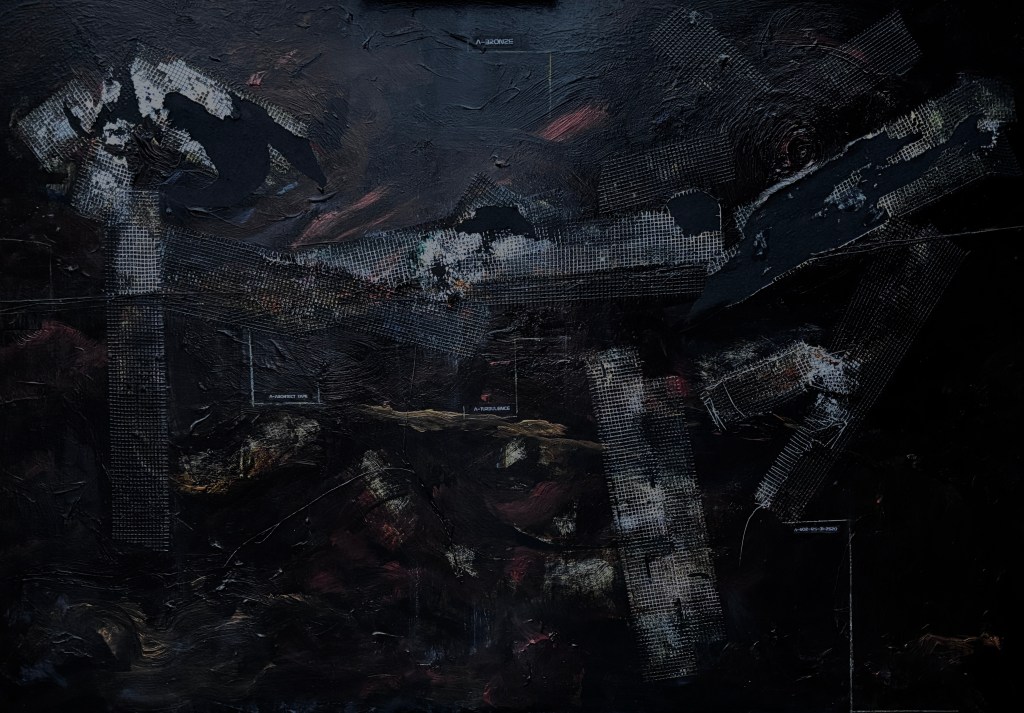
The one below, and three others, photographed using light modifiers, does act as an AR target.
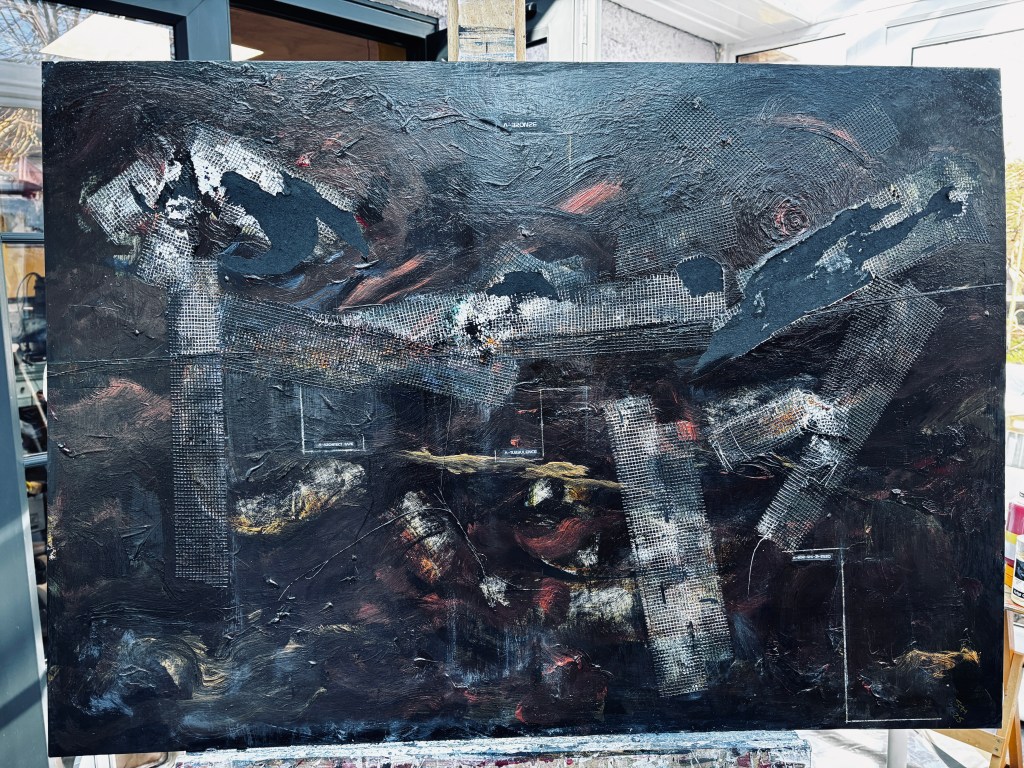
Some things are not bigger than us but can be devastatingly destructive as the dinosaurs would have told us had they survived their own close encounter. In 2032, an asteroid is due to approach Earth with a 1.3% chance of hitting us. Luckily, we’ve rehearsed nudging such an object off its course [https://www.bbc.co.uk/news/articles/cqx9dgpx98go] so that, “In the unlikely event YR4 were headed our way, one option would be to divert it by hitting it with a robotic spacecraft, as was successfully tested out with Nasa’s Dart mission in 2022. That changed the course of an asteroid that was not on a collision course with the Earth. Nasa’s Dart mission showed that we have the means to divert an asteroid, but only if we spot it early enough,” says Dr Massey”. And this, people, is why we need space travel.
SCH 2025
*At the time, it would have been a DipAD (Diploma in Art and Design). Google’s Ai not only doesn’t know when it became a degree but insists it was never a proper qualification at all.
**The Expanse. A scifi series made by Amazon. This started out as a brawl-fest for the boys with one or two token women but matured very quickly into a class act. Used the word ‘bloviating’ in one episode which sets it apart from every TV programme or film I’ve ever seen.
 Conboyhill Arts - art from stART to finish