The experiential catalogue
Let’s call this a sketch pad, a rough diagram, a list, a mental assemblage of elements, an aid to unconscious conjecture about the story I’ve told in this unit and that teeters on the edge of the 3.3 cliffhanger. Fasten your seatbelts.
I’ve used digitally altered photography as reference material for paintings
Written ‘tombstone’ material (no more than 75 words as per tradition) for finished work
I have animated worm dads, scared cats, and novice spiders on their first dangle thread in Procreate and put them in a wild space
I have augmented many paintings with digital layers, including a defensive ditch
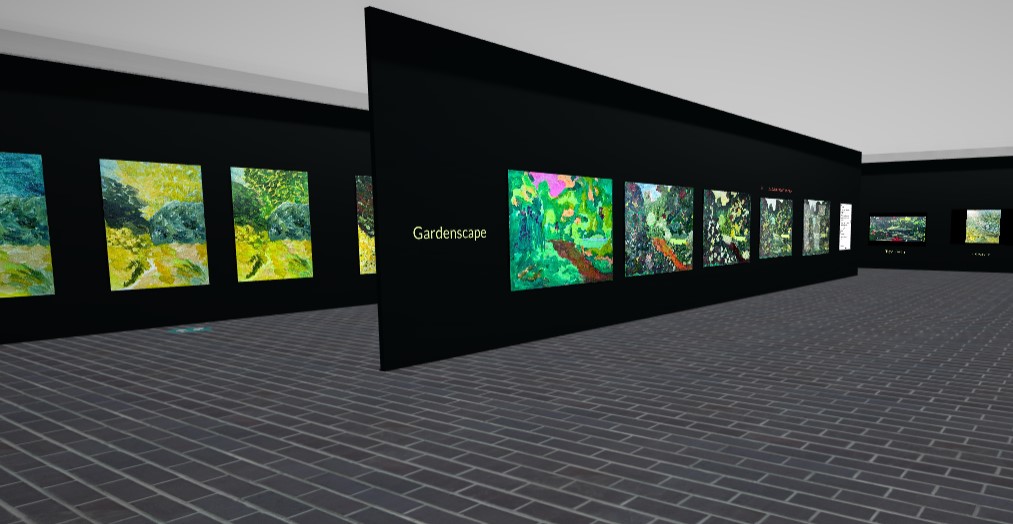
I have built three galleries in two virtual worlds and given two talks in one of those worlds
https://www.artsteps.com/view/66e16e0bdf844cda0493a05b
I’ve learned how to blend images by layering photos and altering their opacities after Saul Leiter’s (b1923-d2013) body of work https://www.saulleiterfoundation.org/
This is an incomplete catalogue of the experience of 3.2 and the work arising from it but it’s enough. It captures the variety, the coherence of purpose, and the progress (like compost, the oldest is at the bottom here) made during this unit. I’d begun counting posts, images, and videos but stopped at the realisation that each of the 70+ posts carried around 16-40+ images, and there were some 43 tombstones scattered throughout.
Summary
A competent primary painting is essential to the whole. The digital layers shouldn’t be enhancers without which the painting would fail, they should be additional windows on the life of that painting. Layering, taken from Leiter’s photography, provides an additional reservoir of imagery, whether purely photographic or incorporated into a digital version of a painting.
Narrative. I’m a story-teller and my artwork feels hollow if it doesn’t have one.
Animation needs to be more subtle than I currently apply it, although part of the reason for it being unsubtle is the need for it to be noticeable on a small screen. Subtlety is built-in by external factors and so the original may need to be large and obvious at source. This matters in AR when viewed through a phone screen but probably less so for material in videos viewed on larger screens and hosted on, for example, YouTube.
3D material can be applied in layers for AR. This is relatively limited at present in terms of the quality of objects available to use via Artivive. The alternative is to make my own.
3D can’t be applied to video although layering and effects can be applied that mimic 3D and the video itself can be supplemented in an Artivive AR with 3D layers.
Green screen is filmic and more suitable for screens larger than phones. It enables ‘windows’ to be created in existing images, whether photos or paintings, and for video or other material to be shown through those areas rendered transparent by the chroma key.
Animations from scratch are a new possibility for me. Procreate is the first I’ve tried although I made a stop-motion animation as shown in Frog Fall. This is another area for further investigation.
Iterations of paintings as in my Iterations exhibition is another concept I would like to explore further. [And thank you, DC, for this original thought].
 Conboyhill Arts - art from stART to finish