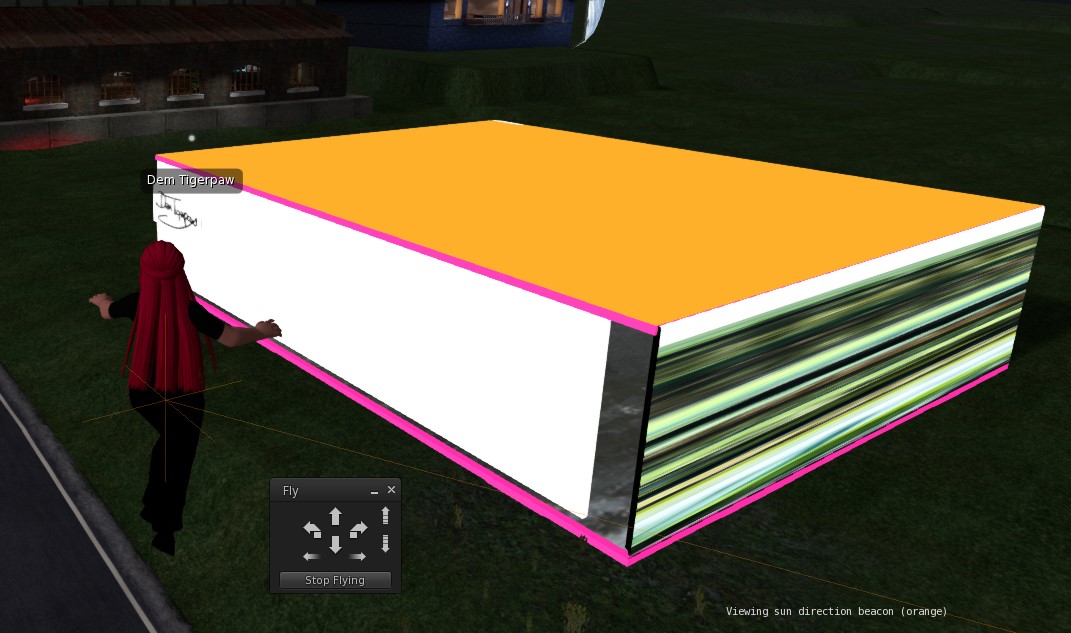
Following one of those tutorials where the atmosphere was electric and excitement leaked out of every pixel, I’m beginning the process of learning how to construct from scratch buildings in Second Life. The start point for this is YouTube and I have found some gems.
This little diamond talks about ‘prims’ (the literal building blocks of SL out of which everything is made) and how to keep their land impact down. Every area of land has a prim allowance which is a bit like weight, so the lower the weight you use up in your build, the more there is spare for other things. In my case, I want to ensure that the gallery I build doesn’t use up so many prims I have none left for the paintings.
Building also requires land which I will need to either buy or rent and I’ve begun the process of discovering which is likely to be best for me by searching through SL for land currently on sale or for rent, and for vacancies in galleries.
In May, I was very lucky to be offered exhibition space by Veyot (in-world name) and to have my work on display there for almost two months. Visitor numbers were high* and I was able to give a talk there which led to giving another talk** at a purpose-built gallery owned by Wren Carling (in-world name) elsewhere. Every painting is an individual texture applied to a cube re-shaped into a flattened rectangle and positioned according to circumstances, and I had to learn how to do that. For building a gallery, the same principles of 3D manipulation apply.
Here’s another video I have found useful and which drew my attention to some elements of positioning and ‘snapping to grid’ I had not understood before.
The majority of galleries I have found in SL have been either large, grand edifices or small shops; and because the population of SL seems to be largely north American (SL operates on California time), the prevailing style has colonial notes. There are some UK-owned places where the style suits the location. New Brighton, for instance, is a small-build of Brighton in Sussex and has some boutique galleries under the pier.
I think though, that I’d like to create a gallery that turns its head away from those extremes by presenting a much simpler face to its visitors and, with an emerging vision of a very simple structure with white walls and black framed windows that smacked of the Bauhaus movement, I have begun the design process in sketches for translation into, initially, an Artsteps gallery.
*Using a visitor counter, which is a basic prim made hollow to accommodate a script or programme and installed at the place to be measured, I recorded episodic visitor numbers in the 30-40 range per day prior to the exhibition, which rose steadily as the residency became known to regular visitors and those alerted by Veyot. The graph below shows a sudden rise around May 13th when the exhibition was moved from the basement area and supplemented at the owner’s request by the paintings of cats. Since then, numbers have tailed off only slowly. Another artist was in residence from July 1st and so the counter was removed.

2nd May. Moved to a basement area in the main gallery.
12th May. Counters installed downstairs and upstairs.
13th May. Moved to main deck with addition of cats at owner’s request.
22nd June. Exhibition formally announced and a party held.
30th June. Exhibition taken down as agreed.
3rd July. Counter removed as a new artist was due to exhibit.
The data are not systematic enough for analysis. It was not possible to collect running data so I had to collect what I could when I visited. At one time I had two counters – one for the basement area where the landscapes were housed, the other for the decking with the cats. When the landscapes were moved upstairs, I deleted the downstairs counter and so the source of the data sets was halved. The counters sometimes counted the same visitor twice in the same timeslot, tagging the two counters even after one had, I believed, been deleted. Both inserted totals that bore no relation to the actual numbers. Because of this, I have gritted my teeth and simply listed in a spreadsheet and with minimal scrutiny the names on the various lists. I was not always able to collect the data and so the curve describing the data lacks a consistent granular reference. Despite that, and with daily collections over the period in question, the sudden rise at June 13-17th coincides with both the move upstairs where passing/regular traffic is more reliable, and the installation of the cat paintings. That people commented on those paintings in particular suggests that this may have been an important factor, and visibility certainly was. It seems that, even when relocation involves little more than a few clicks of a mouse, people are just as disinclined to leave a social buzz as they would be in the real world.
SCH 2024
https://www.gira.com/uk/en/g-pulse-magazine/architecture/what-is-bauhaus#today
Bauhaus Foundation Tel Aviv. (2024, May 8). In Wikipedia. https://en.wikipedia.org/wiki/Bauhaus_Foundation_Tel_Aviv

 Conboyhill Arts - art from stART to finish
One thought on “Physical Digital Hybrid Art”