I’ve been writing about this for a while (essay: Doors to Inception 2023*; dissertation How old does technology have to be before we stop noticing it? 2024*), concluding that, like every implement adopted or created by artists since the first shape was made in mud by someone with a stick, AI is just another tool and we should learn how to use it.
This is what ‘Jim the AI Whisperer’ says in Medium (01/04/2024)
“I worked creatively to get this exact result, with hundreds of iterations and tweaks to prompts until it showed what I saw in my mind’s eye. Michelangelo said that sculpting was about freeing the statue hidden within the marble, and that’s what this felt like for me … Perhaps I’m simply fooling myself, but I suspect that art might lie in the shared space between creator and creation, irrespective of the medium.” [my italics].
Exactly that. Whispering Jim has speculated on the argument I articulated in neuropsychological terms in those earlier essays, that creativity is an emergent property dependent on an unconscious (default brain network) fed with experiences and given downtime to mull. Mulling is what happens when you do things that require no active problem-solving. Things like washing up, going for a walk, waiting for a bus. Then, at an equally inactive moment, it catapults its ideas up into consciousness and we feel inspired to make whatever it is we make. If a muse exists, it’s made of cytoplasm, electricity, and every life experience you ever had.
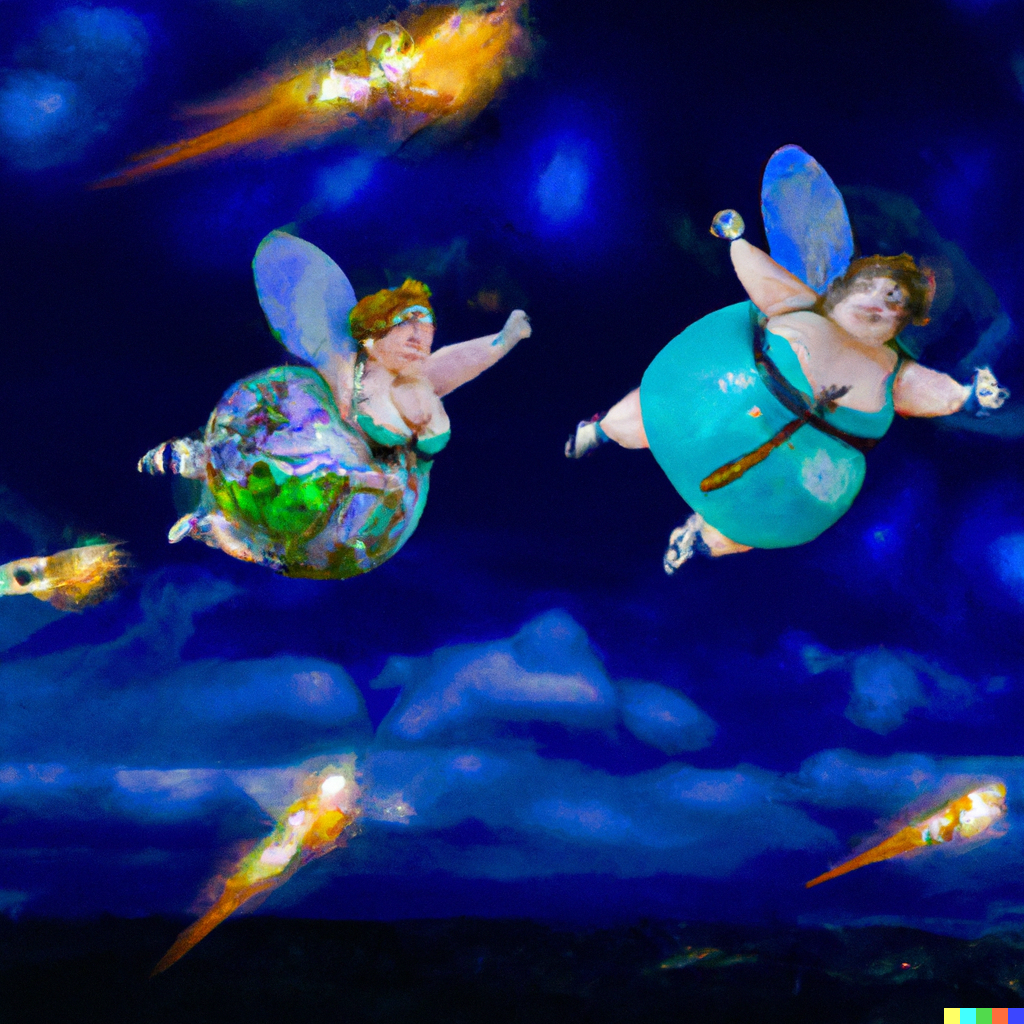
My work increasingly comprises physical, digital, and hybrid layers, including film and audio, all of which I make myself**, and I have argued similarly that, just as I consciously direct the movements my hand makes on canvas, I also direct the behaviours of the apps I use to determine, for instance, where and how animation operates, how saturation levels or opacities work, and whether layers appear as whole entities or through greenscreen windows. I find it difficult to see how this differs from classical painters delegating particular elements of their work – hands, feet, backgrounds – to apprentices (see the Milan Institute article ‘From Apprentice Artist to Master: Art Lessons From Da Vinci’ 2020). I exclude text-driven AI art such as DALL-E because even though I am providing the prompt and then selecting the best representation of that prompt, I have no [literal] hand in the result. I do, though, have a soft spot for one image DALL-E made when I fed it a bit of fiction about Fat Fairies saving the world. Clever DALL-E.
SCH 2024
*Essays. These are coursework and although one has been through the assessment process and probably could be published, the other has not and so they are not yet publicly available.
** Some audio is sourced from free-to-use collections licensed either for non-commercial or occasionally commercial purposes.
Jim the AI Whisperer (2024) April Fool’s Day: I pranked BBC news with an AI image and they published it as a real photograph. Medium. https://medium.com/@JimTheAIWhisperer/april-fools-day-i-pranked-bbc-news-with-an-ai-image-and-they-published-it-as-photographic-art-1e4ae393a4af
From Apprentice Artist to Master: Art Lessons From Da Vinci. Milan Institute (2020). Unattributed. Link: https://www.milanartinstitute.com/blog/art-lessons-from-da-vinci
Default Brain Network (or Default Mode Network) overview, Psychology Today (undated) https://www.psychologytoday.com/gb/basics/default-mode-network
Conboy-Hill, S. (2014). How the Fat Fairies Saved the World. Zouch Magazine. https://zouchmagazine.com/fiction-how-the-fat-fairies-saved-the-world-dr-suzanne-conboy-hill-short-story-month/#ixzz32oYiOyJT
 Conboyhill Arts - art from stART to finish