I am drawing quite a lot here on written responses I made using the 3.2 materials I’d been sent before I became ill. These have since changed in structure and require a different approach, but as the core elements are closely related, there is a great deal in that work that is relevant to the revised unit and so I plan to publish them alongside the new sections bearing the most commonalities. For this exercise, Legacy 3.2 Part Three: collaboration, audience, and social media is relevant.
The new materials refer to an undefined project and I am going to assume that this, in my context, will be a paper exercise or small-scale pilot for a degree show, possibly with a small number of collaborators in the form of a consultative group or artist-participants.
Questions
- What are you going to do for your practical or creative projects?
Develop my landscape painting and photo-collage practice with video overlays and augmented reality. This includes developing animation, video and audio production skills alongside painting practice. For me, the physical image is primary and should be able to stand alone.
2. Are you doing a Critical Review or Dissertation?
Dissertation. Due to a combination of events in early 2023 that prevented practical work, this is written and ready for review. Title: Dreamtime to Screentime – how old does technology have to be before we stop noticing it?
3. What does your research explore and what is your research question?
The dissertation looks at the development of tools in the making of art, from early Aboriginal pattern-making (approximately 65,000 years ago) through painting with brushes and mass-produced media, to photo-editing and AR (augmented reality) and asks at what point we stop seeing novel implements as new technological advances which are ‘not art’.
4. Why have you chosen these practice and research projects?
I use digital methodologies in interaction with physical paintings to create physical/digital/hybrid work, aiming to tackle the notion that digital interventions are not valid as creative tools.
5. How will you schedule your project within the unit structure?
From what I can see, these discrete elements are relatively flexible in terms of content and so my aim will be to meet targets as required and maintain the impetus of practical work throughout as I have done in previous units. I am self-driven with an internal clock although this one has shorter ‘hours’ than previous units.
6. How will you schedule your project within the unit structure?
I have to produce a body of work and a Dissertation by the end of this unit and, barring unforeseen eventualities, I don’t anticipate a problem in doing this. I plan to ask my 3.2 tutor to cast an eye over the Dissertation so that I can make adjustments as necessary. My programme lead is aware that I completed this work early under the guidelines that applied at the time (i.e. it was to straddle 3.1/3.2), and while the unit has been re-written, I don’t see any change to this element. The practical work seems to have no specific requirement and I had begun a new and promising phase in my practice just before starting the unit.
The biggest difficulties may be recruiting people to the pilot study although I plan to approach the art group I joined some years ago and which was responsible for giving me the confidence to apply for this degree. They would be able to comment on the concept per se, how it might feel to put up their artwork in an unusual space, and trusting me with the AR layers. Some members experienced this at Steyning Arts trail two years ago. Finding suitable buildings and ensuring the owners gave permission would be another scheduling issue.
7. Who else will be involved in your project?
At this stage, probably no one but eventually co-artists and a videographer/photographer to document the exercise.
8. Is the project safe and ethical?
For me there are two key issues – what will be viewed and where it will be viewed from, even though nothing can be seen without the app.
I have been doing this locally for three years; some on my own property (our lane’s Advent displays), and others on two buildings in the village.
Viewing Position: I have been concerned to site the work so that viewers would not need to stand in the road, have their backs to traffic, or approach the river while operating their devices and the app. For a larger display, publically advertised but also unguided, I would provide a map of the buildings with AR attached and a clear indication of where to stand to view each one. Finding these buildings will be a challenge but there is more opportunity in Brighton than here because there is a reliable mobile signal in the city. I will be checking this out shortly.
Ethics: the material on display is either wholly family-friendly or only subtly contentious in that the viewer really has to pay attention to detail to pick up any subtext. This, on the matter of mental health, is an example, the lights, music, and flags drawing attention away from the collaged words and images.
There may be no physical paintings or indoor locations and so public liability insurance might conceivably fall under performance rather than exhibition. This is something I would need to discuss with OCA’s legal team. Anyone helping to establish and clarify the process will be guided as to safe behaviour when viewing the material.
As regards safeguarding, when I checked OCA’s safeguarding policy, it seemed to focus only on children with no mention of vulnerable adults. In due course (3.3), I hope to recruit co-artists from a service dedicated to adults with intellectual disabilities so that they could experience involvement in a public art exhibition and see their own work on local buildings, animated and with audio tracks. The risk assessment for that activity and any underpinning activities would be the responsibility of the service, with my involvement and that of service user representatives. I consider 3.2 as offering an opportunity to dry-run a pilot study or proof of concept for this.
9. Resources and budget
This is hard to project but as I need no on-site equipment [but see e) below], the main expenditures would eventually, for 3.2 and 3.3, be:
a) an expanded contract with Artivive which supplies the interface for the AR to accommodate increased views.
b) day rates for the adults from the day service plus costs such as travel and meals while engaging in the project.
c) Contract rates for the videographer or photographer.
d) HEPA filter rental for air purification in enclosed spaces where ventilation is inadequate due to building layout and/or adverse weather.
e) Powered wearable amplifiers/microphones for tour guides.
10. Legacy
This is not one of the categories in the plan template but for me, it’s an important consideration. First, AR brings the possibility of making art more accessible to people who have never engaged because it seems alien to them. Second, it allows for added layers of information on posters, signs, information leaflets, and many other publications such that audio, sign language, EasyRead text can appear in context without mediation by QR code and websites. Third, there is the opportunity to pass on AR skills to the service users and staff for their own use.
The process has both entertainment and communication possibilities that go beyond the original physical artefact and complement earlier strategies designed to support literacy (see Conboy-Hill, 2015).
SCH 2024
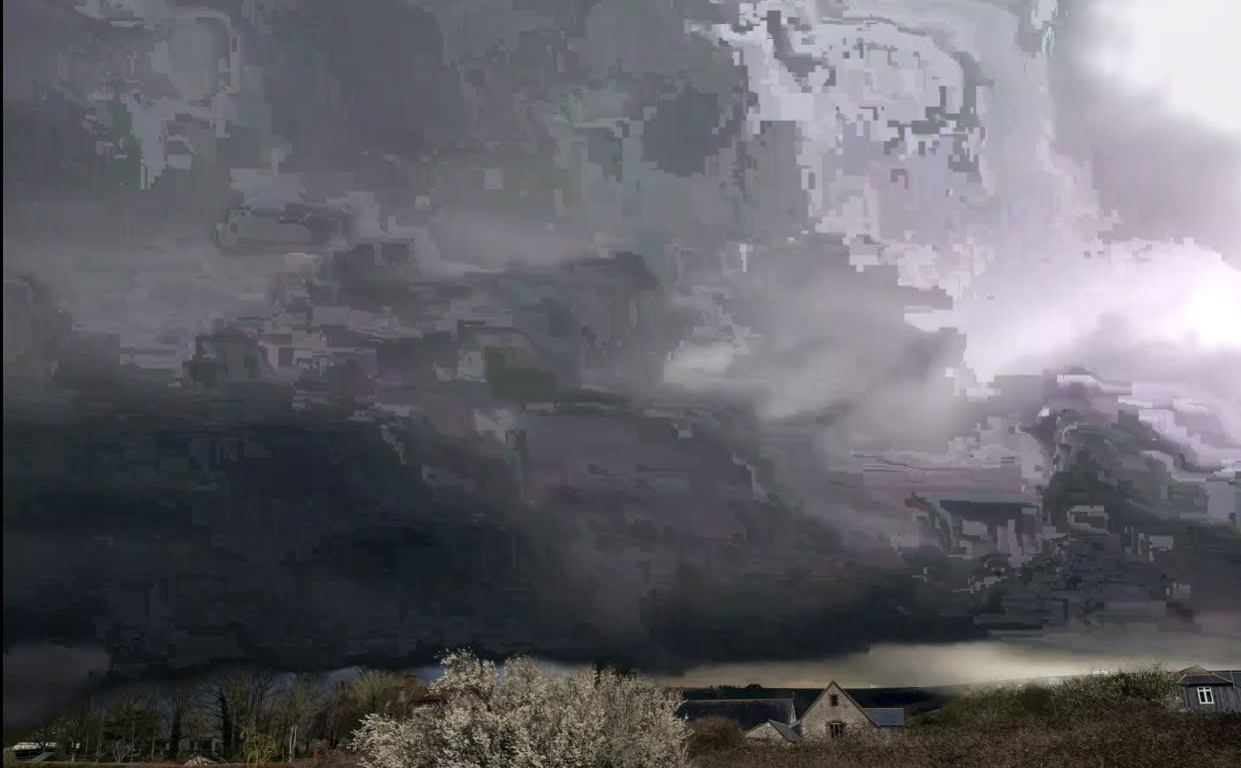
*Painting and collage showing the disconnect between the lives of people in the old institutions – the ‘lunatic asylums’ and colonies for ‘mental defectives’ – and what people saw when they came to open days with bands and refreshments. The title reflects the disconnect between assumed normality (us) and mental illness (them).
Let Me Tell You a Story (2015). Suzanne Conboy-Hill, contributing editor. Lulu. The addition of a QR code leading directly to a recording of the authors’ reading of their own contributions allows struggling readers to read along in private with the audio. More information at Readalong Reads.
 Conboyhill Arts - art from stART to finish