What shape is my practice? Well, there’s a question! After some thought, I’m going to suggest that the shape of my practice is a function of the connections in my brain that the idea of it sets up. But what does it mean, literally and at a more intrinsic level? What does it want to know about itself or ask other parts of my brain about? And now I’m going to shift gear and refer to mind rather than the physical structure that, arguably, generates it.
This is an area best tiptoed through with cautious dependence on concepts that may already be out of date. Concepts such as consciousness and the unconscious or Default Mode Network (e.g. Buckner, 2013). I suspect I’ve described elsewhere (Conboy-Hill, 2023) my home cooked User’s Guide to Brains and Minds which is a consolidated and simplified illustration based on how I understand those systems to work. And to demonstrate that, here’s the fundamental structure according to me:
Top level: a road, bridge, walkway hanging between trees, a conveyor belt. It’s linear and mostly goes just one way. This is consciousness. It sees and processes things in sequence.
Bottom level: a bubbling cauldron of every single experience, idea, thought, dream, imagined image or encounter you ever had. Nothing escapes the cauldron; it’s the repository of everything that becomes a story, an imagined image, a film, a painting. It’s full of friendships, family, love affairs, bullies, pets, holidays, fields, mountains, rivers, seas and deserts. It’s where dreams come from, and, I have argued, creativity.
In between is a net. For some the net is narrow gauge and not much gets through but for others the gauge is so large that everything comes through and overwhelms them. Most of us have something in a range that goes from mostly constrained and predictable to mostly agile and inventive.
In my particular imagination, these two work together, the pathway carrying ideas and the elements of thought along from left to right while the bubbling cauldron lobs up new elements onto the path and sets off new constructions and ideas. The wider the gauge of your net, the more original the elements that land.
So obviously unconscious processing is the most interesting to me because literal linear consciousness is dependent on this heaving, magical, primeval sea of conceptual abstractions.
Luckily, I don’t have to evidence this because it’s an illustration of something neuroscientists don’t necessarily have a grip on anyway. Also luckily, is good evidence that the Default Mode Network (DMN) is the cauldron and that it does its work while the linear, strategic, what-next part of the brain has gone into idle mode while it washes up or walks fields, or runs, or stares at a wall. Daydreaming, doing nothing, idling, is what it needs to do its thing, and its thing is collecting and processing information to throw up onto the conveyor belt. To achieve this, the physical underpinning of the DMN, the brain, freely connects with every part of itself so it knows where to find a smell, a sensation, an emotion, a snatch of music, an image, a sudden visual memory combining all five.
For me, this is the muse; a state of mind rather than an unreliable entity. Fill your cauldron, set it free by daydreaming, and it will supply you with unexpected images and thoughts.
I suspect ‘blocks’ are unexpected contractions in the size of the gauge. Stress, pressure, fear of failure, illness, seem likely causes, and each will have its own route to a solution. Mine contracted substantially during a period of upheaval that began around this time last year and persisted for many months. It had only just recovered when a virus hit and I’ve already described how it feels to be a computer with an out-of-date operating system and no keyboard! Fortunately, that resolved itself quite recently such that I was able to enrol for this course. I wouldn’t have been capable of writing these posts otherwise.
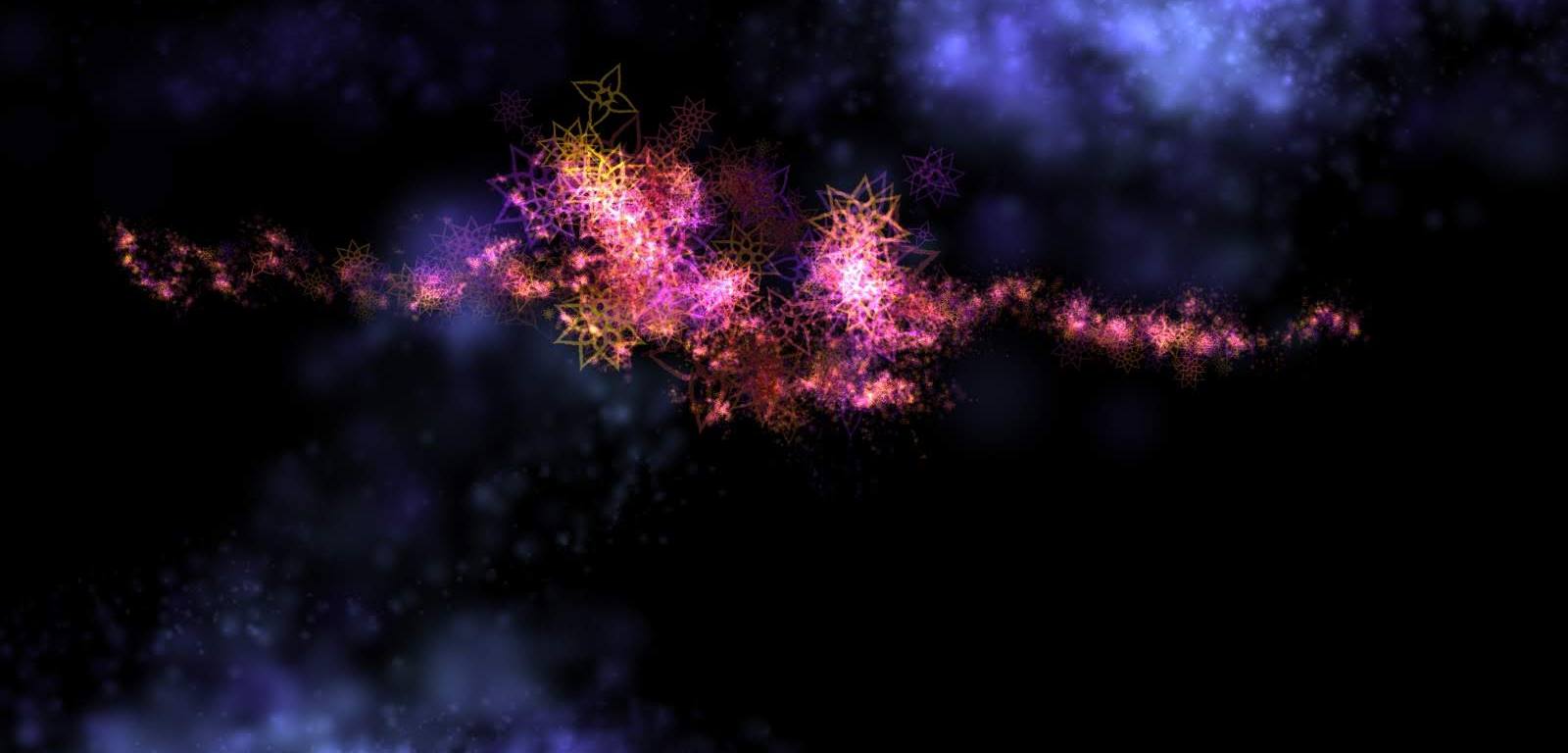
So what shape is my practice? Imagine the image of the universe, full of stars, dark matter, gravitational waves bumping things up against each other, black holes leeching light out of one patch but quite possibly exploding it back out somewhere else. Neurons are spaceships, wormholes capable of travelling from one part of the universe to another; neurons at the speed of light – straight there, no messing; spaceships stopping off at planets, intergalactic cafes, trading and gossiping, making friends, and making memories along the way.
When the gauge of my net is at its widest this is how it feels. Not one place, not one idea, not one identity although occasionally I have to remind it of this when the weight of its physical representation has tightened up the apertures by setting the conveyor belt off on a mission to succeed. I’ve discovered I need wide horizons rather than goals. Somewhere for my atoms to explore when they get back from the Oort cloud or Ophiucus or Gallifrey. Not that they ever left (Stuart, 2022 on quantum particles being in two places at once).
Buckner, R. L. (2013) The brain’s default network: origins and implications for the study of psychosis. Dialogues Clin Neurosci. 2013 Sep; 15(3): 351–358. https://www.ncbi.nlm.nih.gov/pmc/articles/PMC3811106/
Conboy-Hill, S. (2023).
Stuart, C. (2022). 10 mind-boggling things you should know about quantum physics. All About Space magazine. https://www.space.com/quantum-physics-things-you-should-know
 Conboyhill Arts - art from stART to finish