The first paragraph of this section warns against the ‘narrow focus’ and ‘head down’ approach to the final units of the degree and challenges us to be more daring, to make leaps and fresh decisions about what our painting could be. This would be music to my ears but for the fact that I’ve never been able to develop a theme with patience and perseverance and this came up as a criticism in the feedback from 3.1.
This isn’t new and it isn’t unique to art. My working life, while drawing on the same range of skills, differed with each encounter with a client. Every written report was different, and every set of notes. This extends to fiction; I prefer to read flash and short stories rather than novels, and my writing is the same. Short pieces in settings ranging from grim contemporary realism to magical realism to science fiction. I’m a search and rescue helicopter, I’m not The Ghan*.
So, noting that recent graduates all had an identifiable theme for their graduation collection, my objective is first to find one I can stick with, and second to be daring within that tram line.
Taking Stock
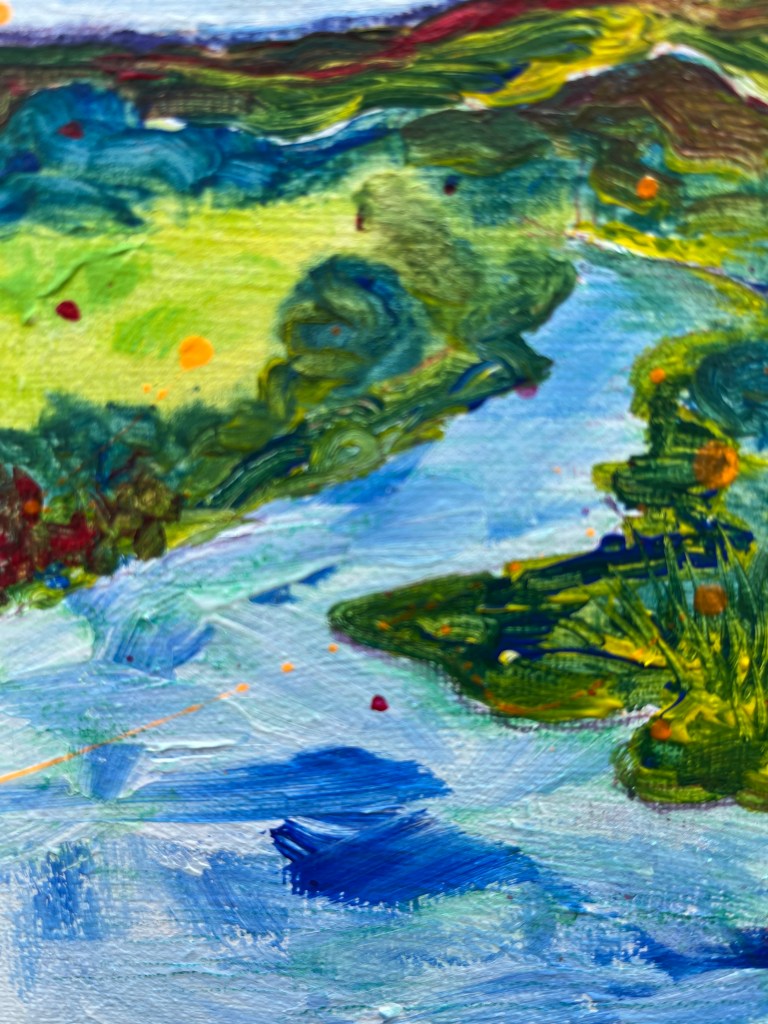
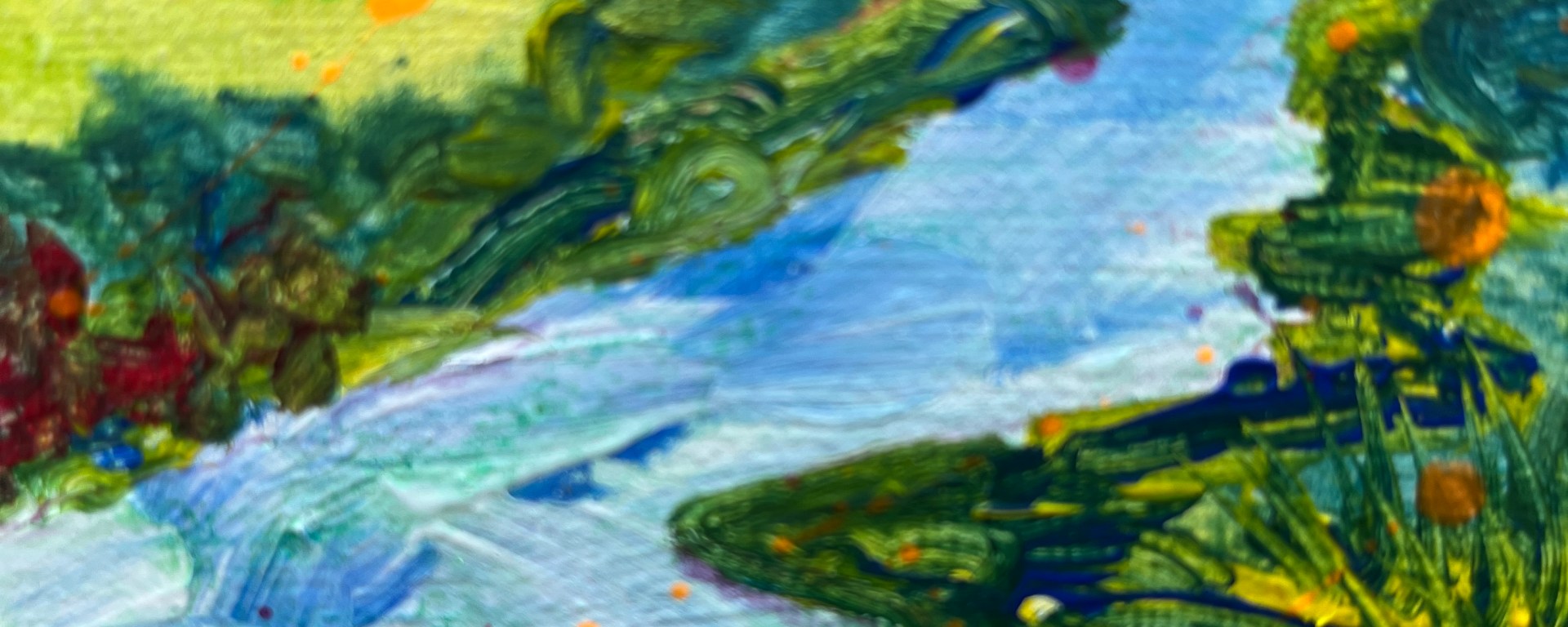
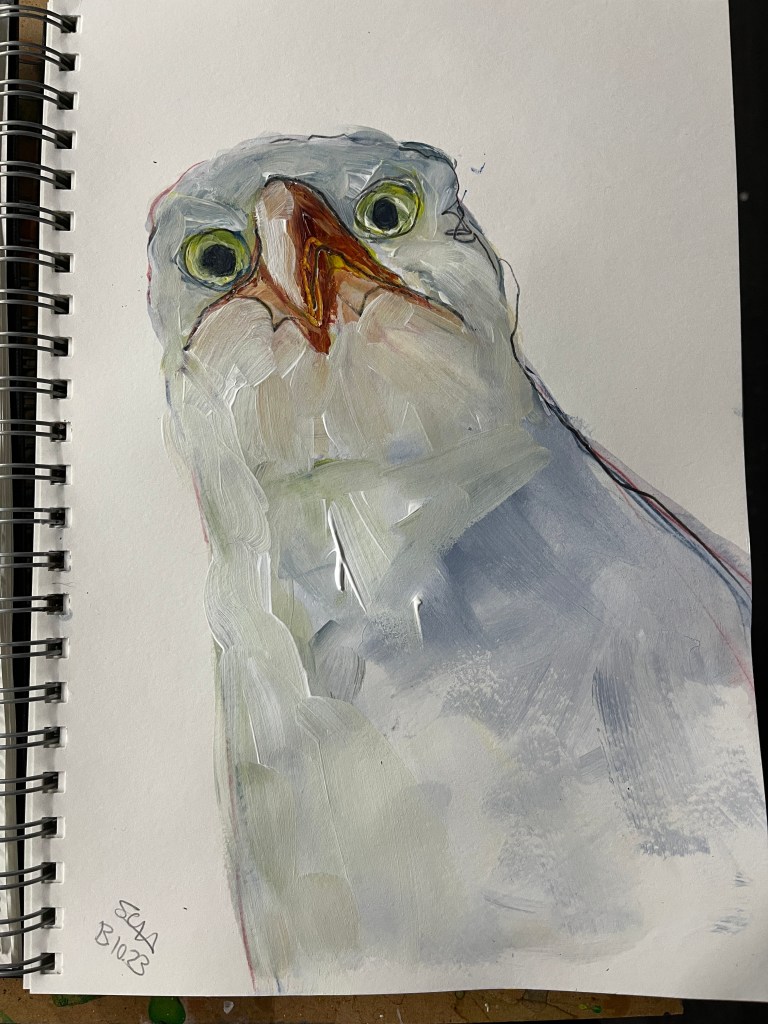
My core concern is that my imagination outstrips my competence with paint. I’ve been trying to tackle that by making landscapes on whatever came to hand so that I was forced to adapt. Using my own photos which hold memories of place within them, I made paintings on whatever size canvas surfaced next of summer and winter scenes. Then sketchbook paintings of shirty-looking gulls on Brighton seafront.
Latterly, I’ve hauled out my portfolios from school A levels and Brighton foundation year and begun to update some of those. I’m particularly keen to (and fearful of) updating some of the figurative work because I can see I had a handle on perspective that I seem to have lost. Is this wonky eyesight, maybe? I do wonder as one eye likes distance and while the other likes a lot less distance, neither likes up-close. The two are out of sync and the lenses aren’t flexible enough to adjust. Perhaps this is why I tend to make flatter work than I obviously made in the past.
Analysis
I have definitely enjoyed being exploratory and interpolating the visually engaging with some hard-hitting political undertones that I applied using AR (Augmented Reality). Some of that got lost during 2023 when personal circumstances overrode creativity and I retreated to the familiar and unchallenging. I only recently emerged from this derailment and felt the creative embers beginning to spark.
Scale
To some extent, physical scale is less of an issue than it might otherwise be due to the ability of the AR app to put good resolution work onto the sides of buildings without a) requiring any ladders or roadies, or b) leaving any kind of mark on the building itself. One local businessman whose permission I sought before putting an animated piece on his wall is, I suspect, still wondering where it is.
I stumbled over AR and downloaded the Artivive app without a clue as to what it was. I found I had other apps on my smart devices that could animate static images. And I realised I could pair these with the original images on the Artivive bridge.
Until around late 2020, I had never made a video, even on my phone, but the drive to add something new and to extend the capability of the AR layers led to my exploration of video suites. First Filmora then Cyberlink’s PowerDirector, both of which offer a range of transitions (between sections), colour adjustments, opacities, and many other features. They also allowed for the integration of audio tracks, most of which I got from Epidemic Sounds which offers royalty-free tracks for non-commercial use.
That aside, physical scale is important to me in that A1 or A2 makes large movements possible and only permits small detail as and when it fits the overall scheme of things. I can see from a distance things in a painting that I could not see close up and sometimes these shape the end result. This has not yet stopped me from fiddling and over-working although at least I recognise when I’ve done that so my next trick will be to stop before that point.
Series and Multiples
I think all of the above indicates that I am not predisposed to make either a series of small paintings nor multiples of anything! This also goes (with bells on) for repetition and, for different reasons, performance art, even fully clothed.
Aboriginal Art
I have written quite a lot about this in my dissertation, tracing the use of tools back 65,000 years and questioning the resistance (in some art aficionados) to technology. For the Aboriginal peoples, art was communication, drawn from the Dream Time and carrying important insights into the nature of the universe. We still do this in our own way; Kysa Johnson for instance, responding to work by astro physicists; Lisa Pettibone who has made work that went to the International Space Station (ISS); and Helen Schell who is a visual artist, ESERO-UK Space Ambassador, [and my sister’s best mate from art college!]
I have no time for self-indulgent material; personal disclosure that borders on narcissism or that, usually in men, seems little more than an expression of coercive control where the audience is the victim; or the use of materials without, it would seem, the valid** consent of the people who contributed them. I’m deliberately refraining from citing examples to avoid angry objections and lawsuits.
I also find that quite a lot of contemporary art passes me by. I have no idea why it is judged good or merits the adulation it seems to elicit. Some seems naively or knowingly exploitative. Psychology, particularly the branches focused on groups and how judgements are made in the context of powerful social influence and lack of objective (measurable) evidence, provides a framework for thinking about this and I have discussed it in my ***Dissertation.
Luckily I came across Saul Leiter through attending, of all things, an OCA IT course aimed at considering the use of AI chatbots as part of student support delivery. Leiter is a photographer who layers his photographs using different opacities to create some stunningly mysterious images. I began replicating this technique photographically using my own photos, then painting the landscapes featured and trying to add the semi-opaque overlays. This, to my mind, muddied the landscape and so I worked to put this into AR instead. Two streams of work arose from this, the first a series of paintings overlaid with semi-opaque intrusive images (built environment into the natural world) and layered further using digital methods for the embedded AR, and second a drive to improve my painting per se on the grounds that the painting should always be able to stand alone. The trail of my progress in that begins here and is leading to the generation of some very large and very small paintings, mostly in a style that might be recognised as mine but with the smaller canvases leaning more towards the graphic due to limitations on the size of the brushes I can use in small spaces.
I love a challenge and randomly using whatever comes to hand in my studio – cartridge, wrapping paper, card, cardboard, old paintings, canvases, large, small, ridiculous off-cuts – forces me to adapt, and something new always comes from that.
SCH 2024
*The Ghan is a train that cuts across the island continent of Australia from Adelaide to Darwin. BBC documentary now on YouTube
**Valid consent means the person has not only been informed of what will happen/how their contribution will be used but actually understands what that means. This has implications for much of the consenting process but is particularly pertinent where vulnerable people are involved or where it’s not possible to know who, in any given sample, might be vulnerable.
*** Dissertation titled ‘Dreamtime to Screentime: how old does technology have to be before we stop mentioning it?’ Conboy-Hill, 2023. Due for submission 2024.
 Conboyhill Arts - art from stART to finish
One thought on “Legacy 3.2 – Part One Consolidate and Experiment”