
November 11th 2023. I applied for this unit last week and expect to receive the materials in early January. In the meantime, I want to dissect the title because one word is bothering me – Audience.
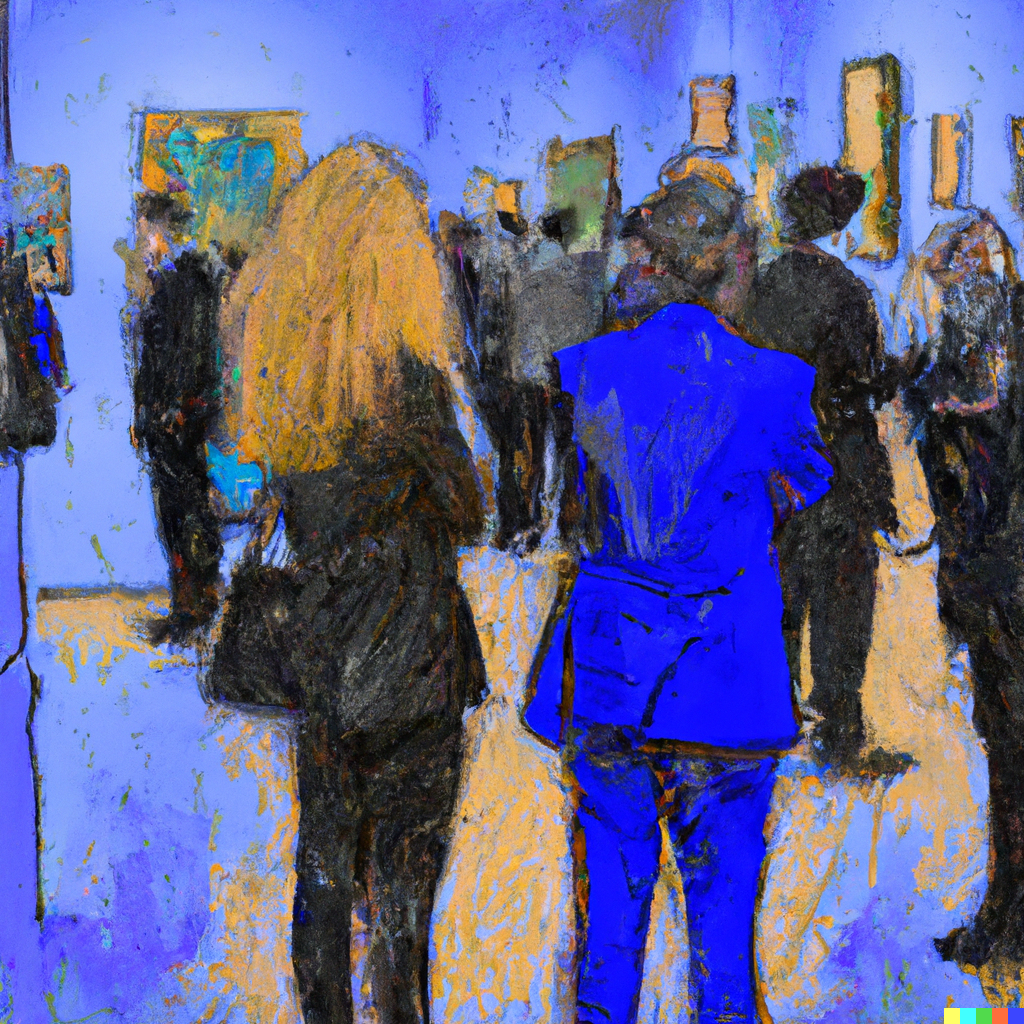
To me, an audience is largely passive and often captive in that doors have been closed and a degree of silence is expected*. Leaving is restricted by convention and etiquette to intervals and the end of the performance. Viewers of art, by contrast, have freedom of movement in the space** and freedom to leave at any time. In fact many do, spending on average around 30 seconds (Getty Museum, undated) looking at each painting.
Sometimes though, they become participants, active observers or, in the manner of pantomimes, semi-coerced performers. Abramovic made her visitors squeeze through an entrance between her and her partner who were both naked (Imponderabilia, 1977). In another exhibition, she invited visitors to sit at a table with her for two minutes in complete silence (The Artist is Present, multiple dates). Tracy Emin (1998) put her bed on display, used condoms and all, a man in Germany walked to the corner of a main street (reference currently elusive), removed all his clothes and left them, along with a brief case, and walked away totally naked [where to?]. Many others have painted themselves splayed and at scale and invited visitors to view them at crotch level. I don’t think this is an audience, I think these are participants.
Arguably, they at least have an idea of what to expect although, since museums and galleries also admit children and young people, I wonder at the safeguarding strategies put in place for them. Personally, I have never seen any content warnings at any of the galleries I have visited of the kind we might expect for TV or films, although Gorrill (2020) noted that her exhibition of paintings depicting submissive men was cordoned off by police. Evidently, she notes, it is thought natural to see naked women in these kinds of contexts, but not men and so her work got special treatment.
November 30th. The work I’ve been developing over the last two years is explicitly designed to be participatory in that it requires an app (Artivive) to see the digital layers and, given one arm of my ambition is to bring art to the public rather than expecting the public to make the effort, I am careful about the content.
Much of the work has a political edge, some of which is only apparent via the digital layer and even then, quite subtle. ‘Blue Passports’, for instance, is at first glance a scramble of images within a union flag, and only at close inspection gives hints of the divisions across the UK caused by Brexit. The AR also drops hints but the music of the marching bands would probably mask the message for anyone who didn’t want to look more closely.

The ‘Fishing’ piece, (now renamed Monsters), employs shock tactics and I would issue a warning and/or limit access to material of this kind.

The other arm is suitable for children and families, and I install it in places where there is a decent phone signal, at least intermittently.
This is one of my first pieces; a painting of the seal which appeared in our nearby river during lockdown. It was the first seen here for many years. I overlaid the original image with video (free to use for non-commercial purposes) of seals swimming underwater. At a local exhibition, it resulted in conversations with adults and children about conservation and wildlife.

There is no painting the image below; instead, I’ve used a number of apps to assemble effects on a greenscreen background (the side of the building) and place transparent png files to give a 3D effect. The audio track is free for non-commercial use.

For me, engagement with audiences begins with making the work accessible to people who ‘don’t like art’ but unconsciously appreciate the art that underpins every visual experience they have from films, to theatre, to book covers, to TV drama, to the design of a new car, to fashion, to style, to the colour or shape of a building. So my ambition is to put art on as many open space sites as possible which means knowing who my audience could be wherever that is and considering sensitivities, sensibilities, morality, mental health, and what it might mean to flash your app at a piece of graffiti and see whatever it is I have put there.
- I discovered recently that labels – or tombstones as they’re called – for paintings in galleries have a standard format which includes a word count. Intuitively that seemed right but I had never seen anything evidential or that might constitute a guide until this week on Sky Arts’ Portrait Artist of the Year. It seems while the word count is critical, the style is up for grabs and a document from the V&A describes the shift from ‘curators talking to curators’ to a much more public-facing and accessible description. Some are poems.
- Applied the tombstone principle to the pieces above. The poems are my own.
SCH 2023
References
30 Second Look. J. Paul Getty Museum (undated)
Abramovic, M. (1977). Imponderabilia. First performed at the Galleria Communale d’Arte Moderna, Bologna, Italy.
Abramovic, M. (2010) The Artist is Present. MoMA.
Emin, T. ( 1998) My Bed.
Gorrill, H. (2020). Women Can’t Paint. Bloomsbury Visual Arts.
Kaplan, I. (2017). How long do you need to look at a work of art to get it? Artsy.
Smith, J. K. (2016) Time Spent Viewing Art and Reading Labels. Researchgate.
Additional material
Artivive. “Artivive was founded by Sergiu Ardelean and Codin Popescu in January 2017 in Vienna, Austria. We’ve built a highly motivated and creative team of professionals and senior developers to help us become the augmented reality solution for artists and creatives.” From their website https://artivive.com/
Conboy-Hill, S. (2023) Doors to Inception. Essay written in fulfilment of L3 module 3.1 requirements and lodged with OCA.
Conboy-Hill, S. Dreamtime to Screentime: how old does technology have to be before we stop mentioning it? Dissertation written in fulfilment of L3 modules 3.1 and 3.2 requirements. Completed but not yet submitted.
Earlier relevant blog posts
—
*Excluding street performances and, for example, pantomimes and performances of The Rocky Horror Show.
**Excluding formal tours and visits to see high-profile pieces of work.
 Conboyhill Arts - art from stART to finish
2 thoughts on “Stage3, Unit 2: Site, Audience, Context”