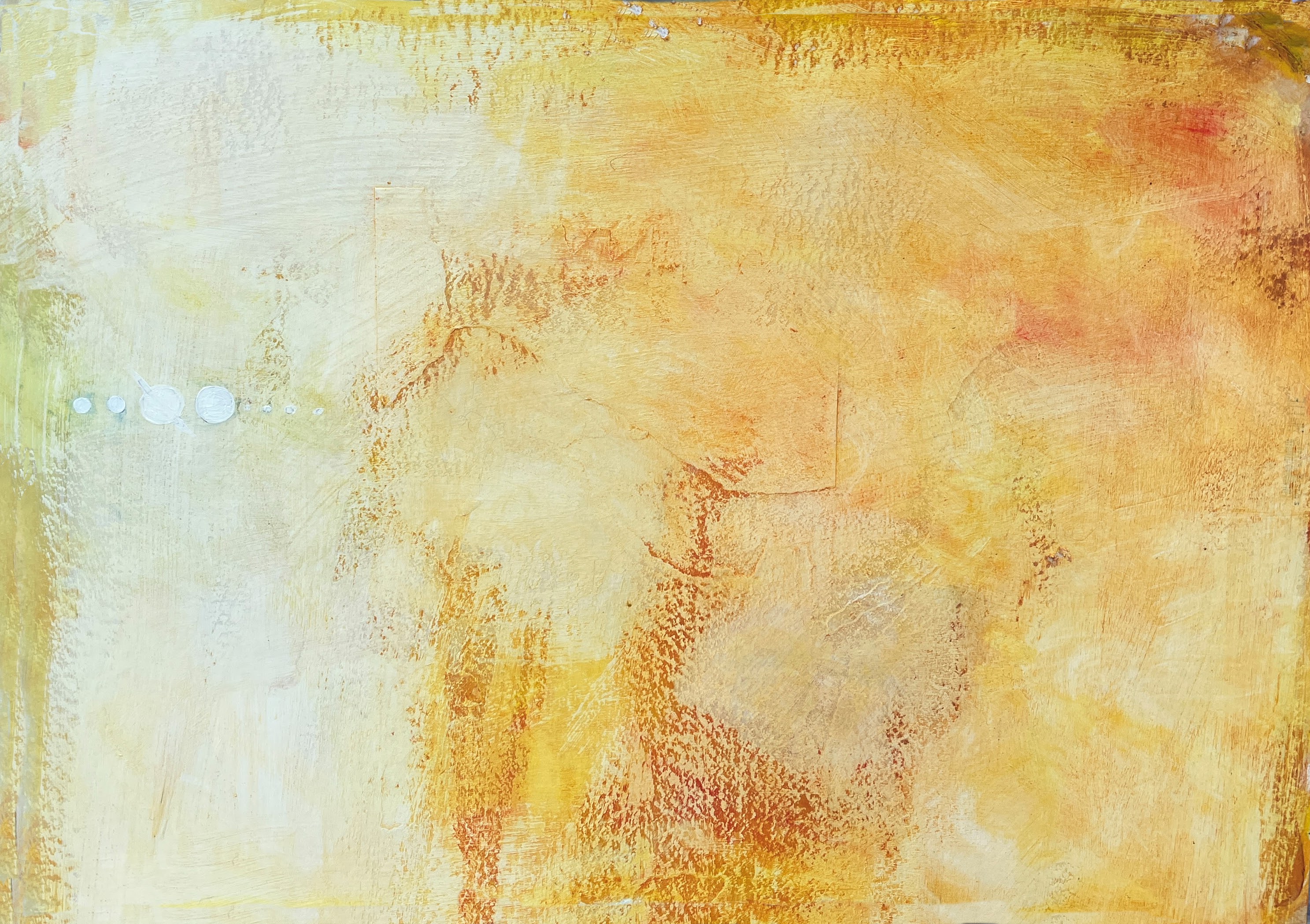


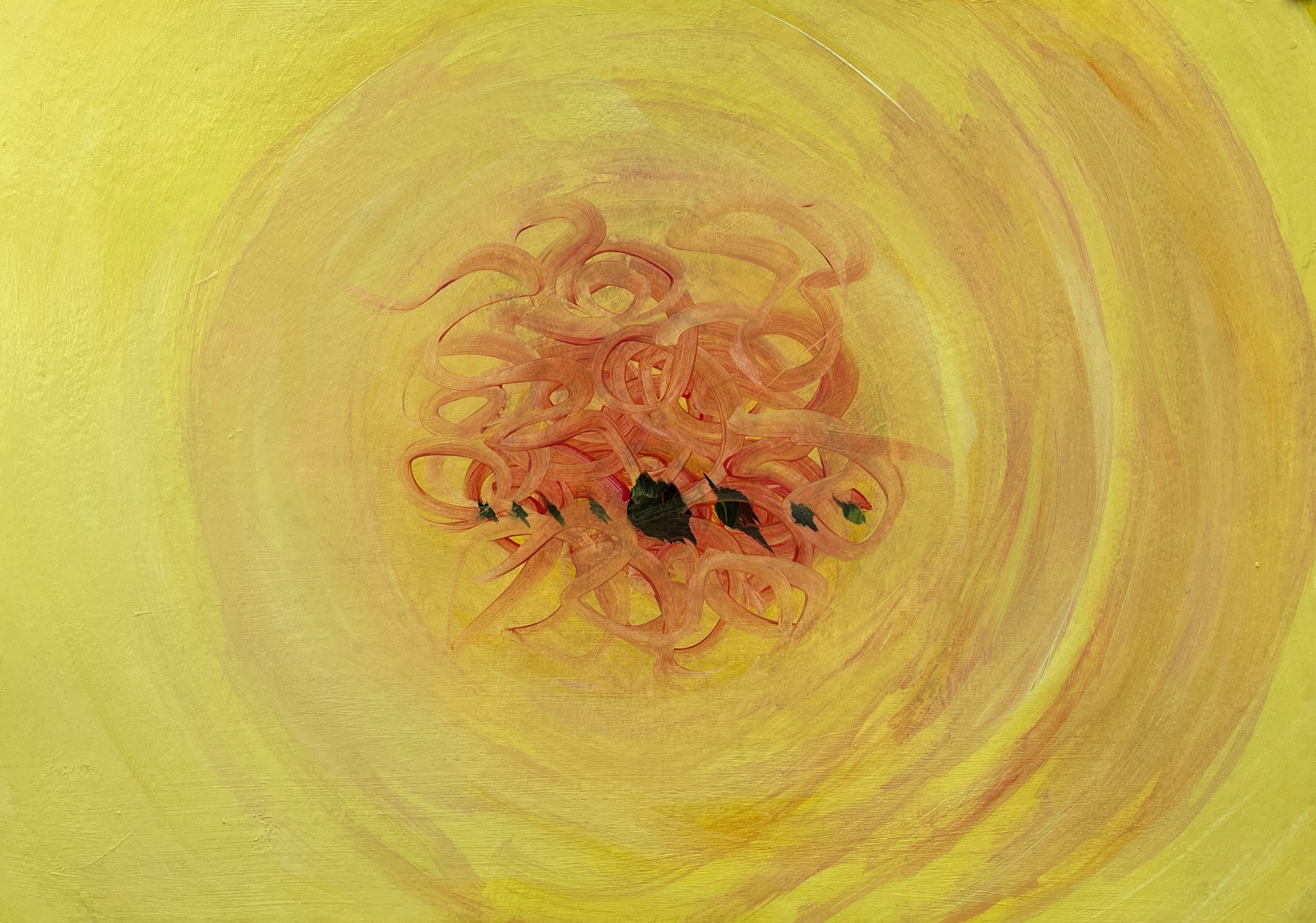
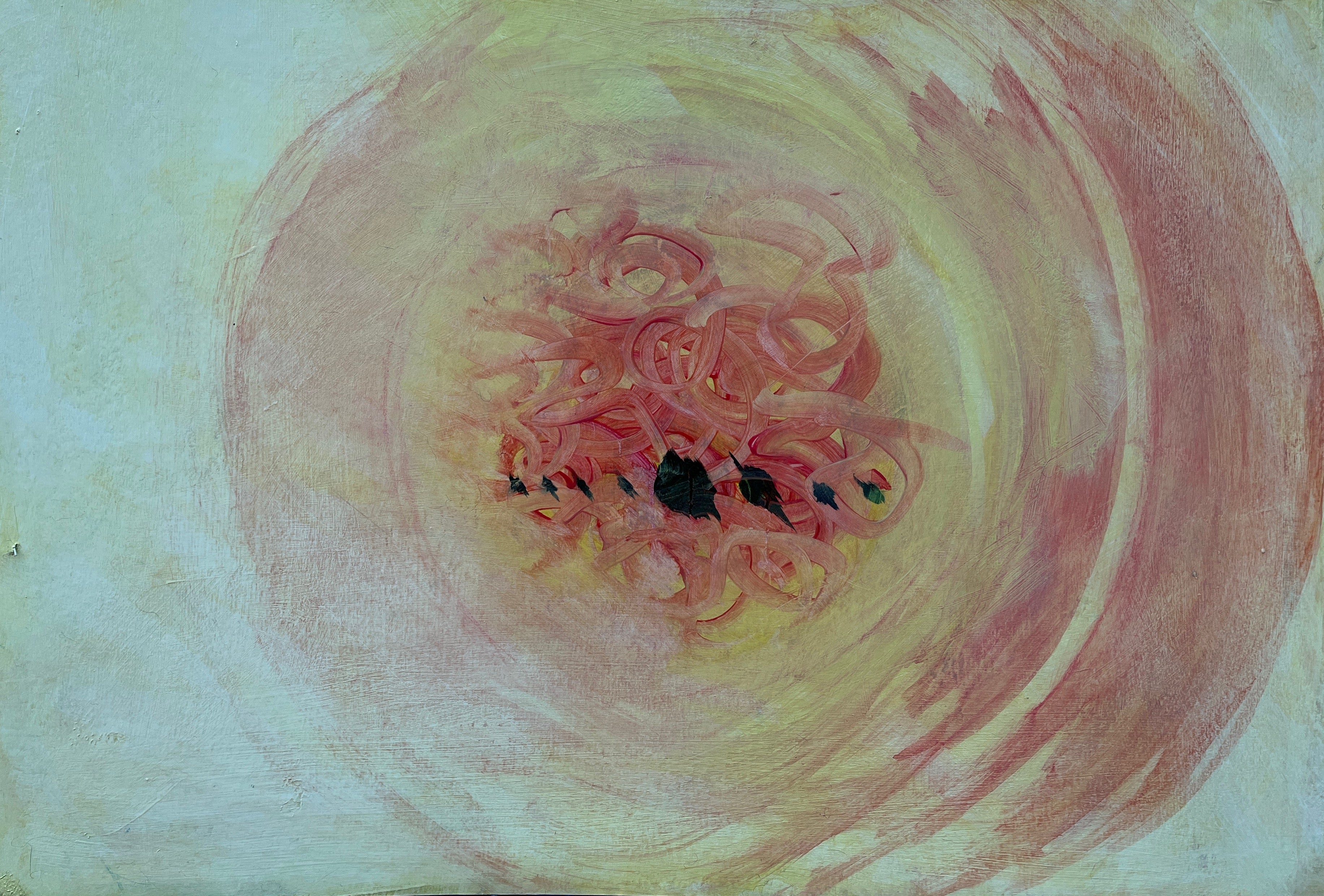
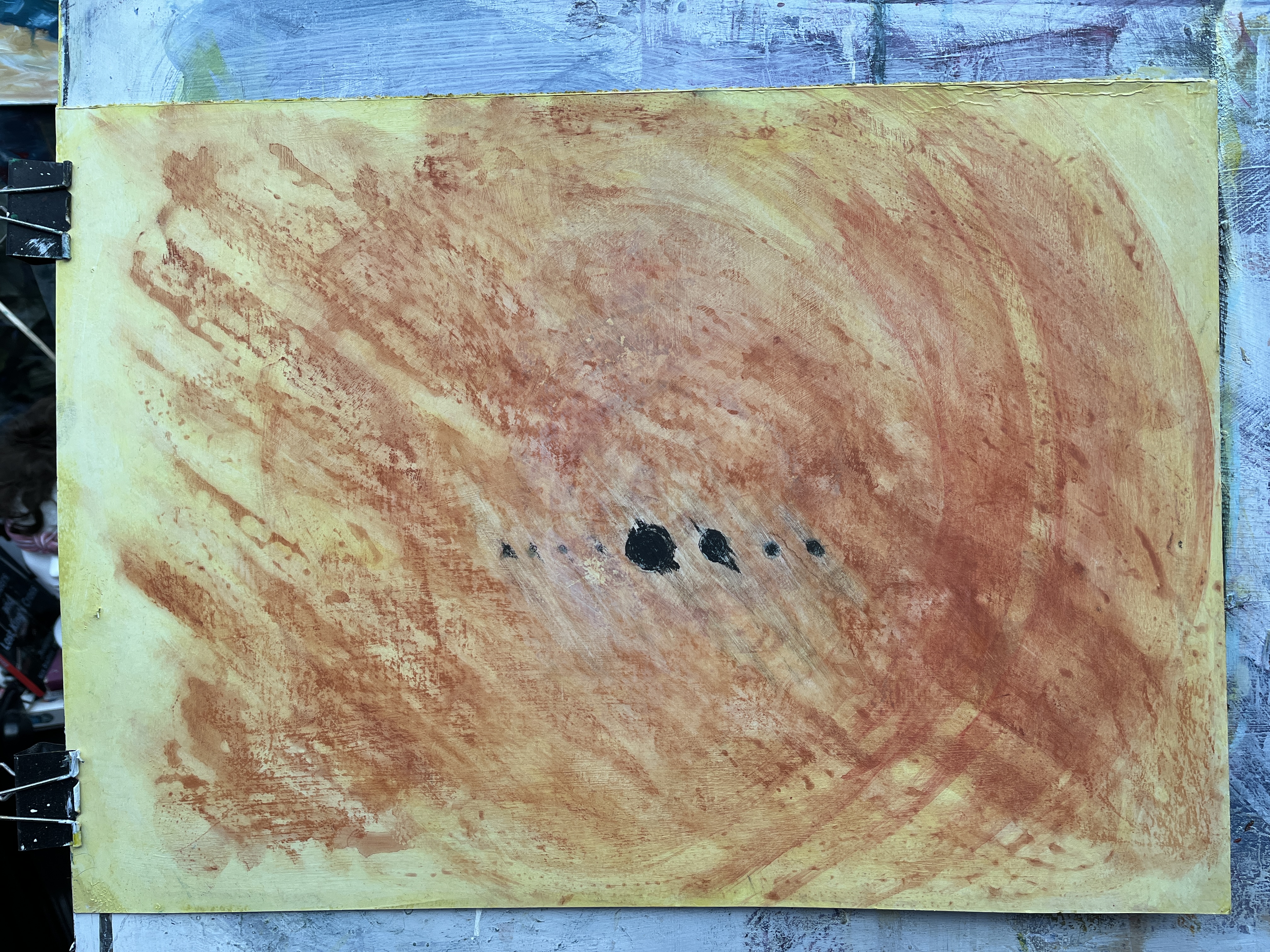
I’ve lost track of the dates here but this eventually became something rather different, and with more of a nod towards the shapes we see in clouds and mists. The planets are still there but this time being slightly distorted by the solar energies behind.


19th April.


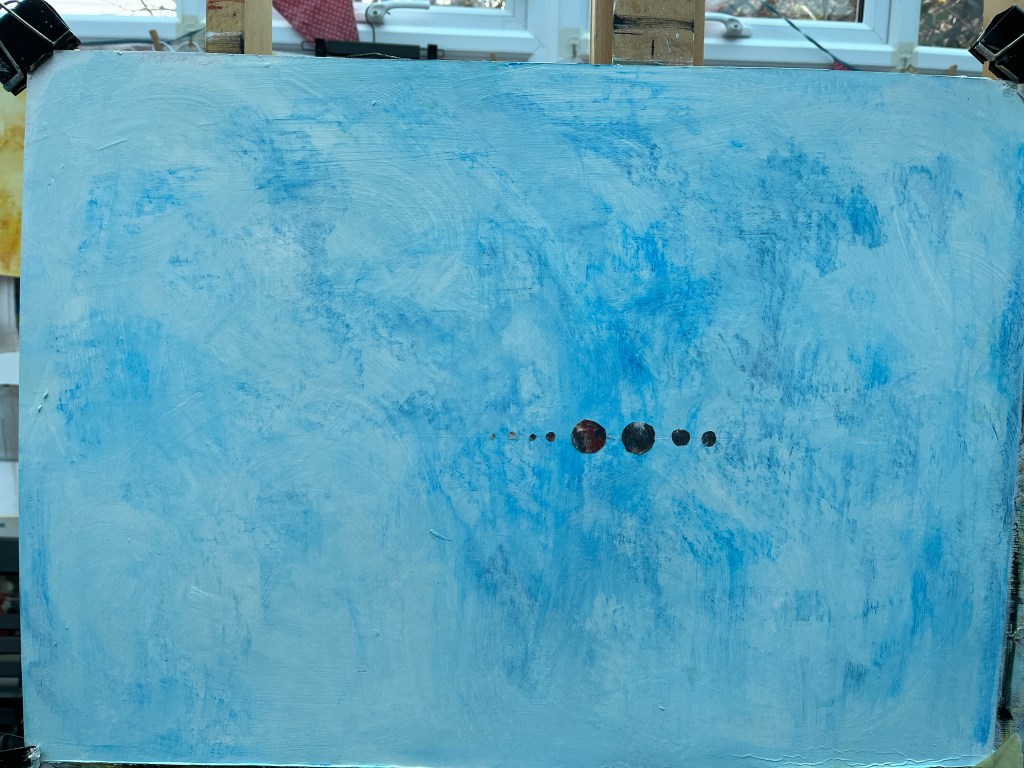

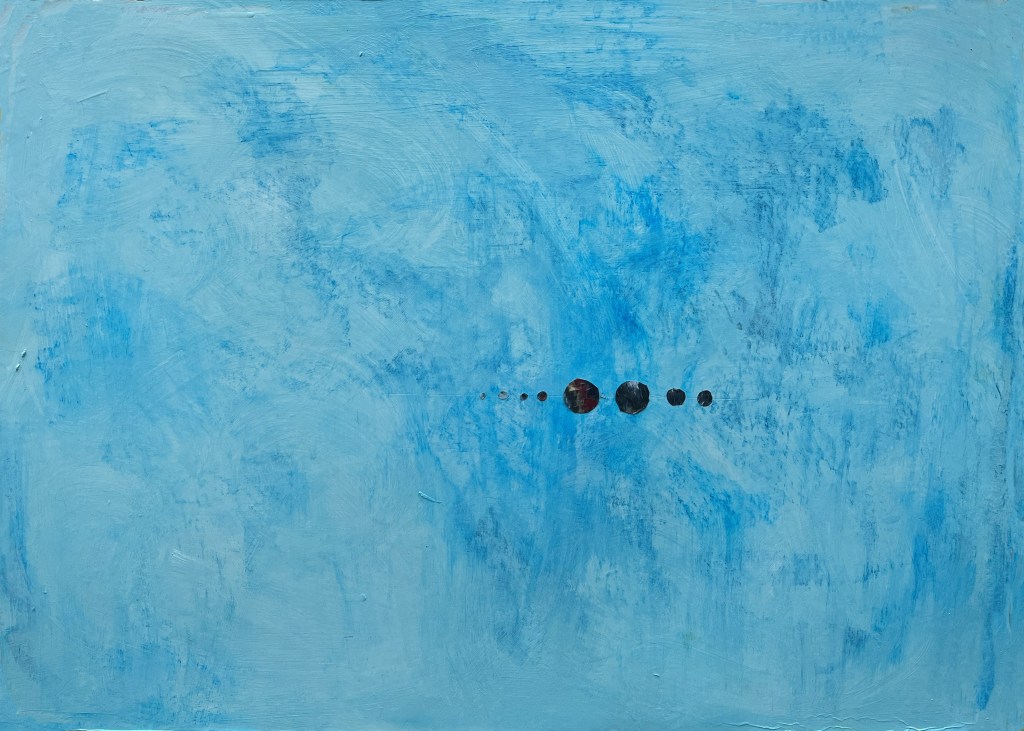


This, to me, has turned out to be a much more rewarding piece than some of the others. Simultaneously complex and simple, it’s given me a way of expressing the depth and movement of deep space without a single flashing light.
Quantum physics probably has a view but as someone who has only a tenuous grasp on the notion of ‘superposition’ for which I thank Carlo Rovelli’s 2021 book, Helgoland – I’m going with a referee who either sees the foul or doesn’t and can’t see both at once – I’m inclined to leave that kind of speculation alone.
We’re going to be entering the Naming of Parts* phase shortly. The primary mover in this was Cixin Liu’s dispassionate description of the gradual flattening into 2D of the solar system, and so the first piece was named ‘Flattening sun’ which, in retrospect, says nothing helpful. It shows the small white silhouettes of the planets of our solar system alongside a huge, expanding sun.
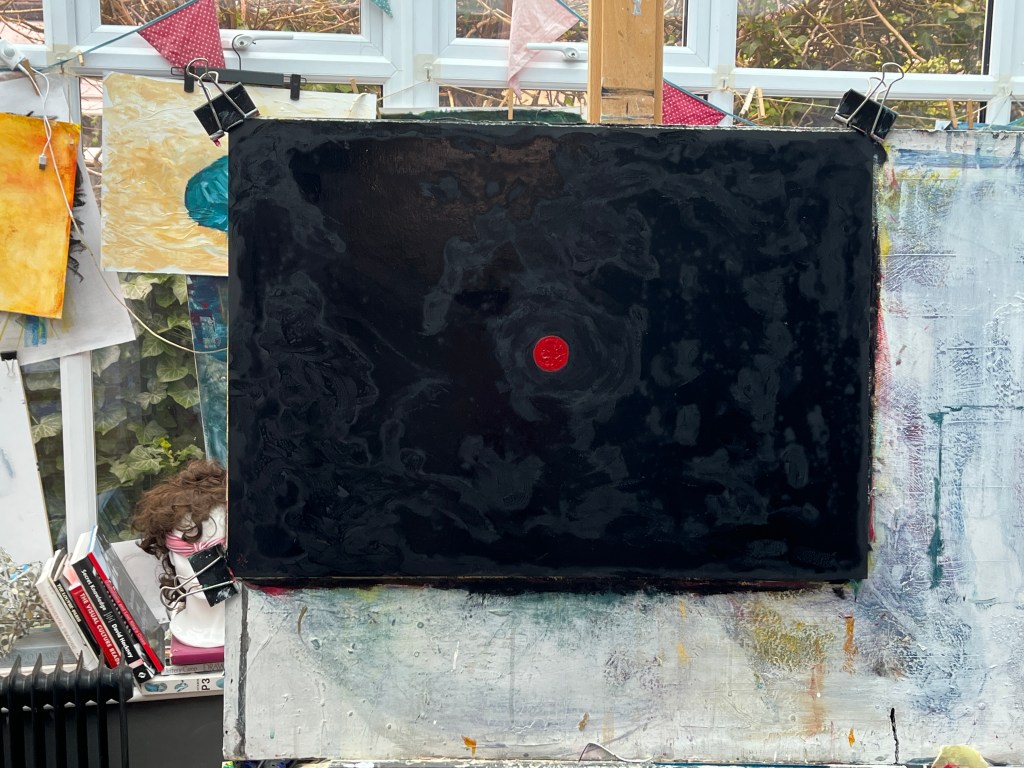
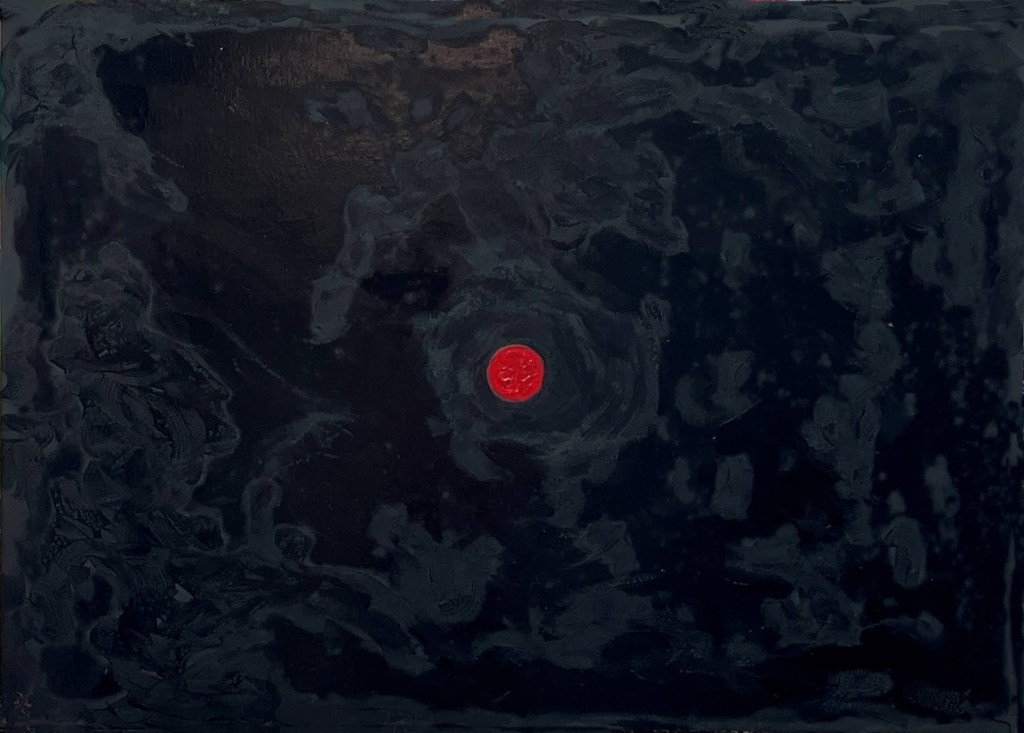
The second piece is about further expansion, the solar system in black silhouette in its line of boiling fire, while the third is the white blast of the supernova. Finally, there’s the red dwarf. Burned out, the solar system nothing but atoms.
Only the first is finished, the others are subject to further interference as they catch my eye.
There may be a fifth although, while it’s conceptually chilling, I’m not sure how I might represent a completely dark and silent future expanded universe. A sheet of virgin black card feels a bit cheeky. Perhaps a black hole would be more illustrative.
20th April. I’m going with the expanding universe because that always raises the question – expanding into what? I’m not sure, as three dimensional beings, we’re fully equipped to visualise the sort of expansion that doesn’t require there to be a space around the item that’s growing in size, and as many illustrations use a balloon as a model, that external space is quite apparent. So I’m going to imagine my universes and what might be outside them just to add another question predicated on the existence of an external space, what would happen if the expanding balloon burst?
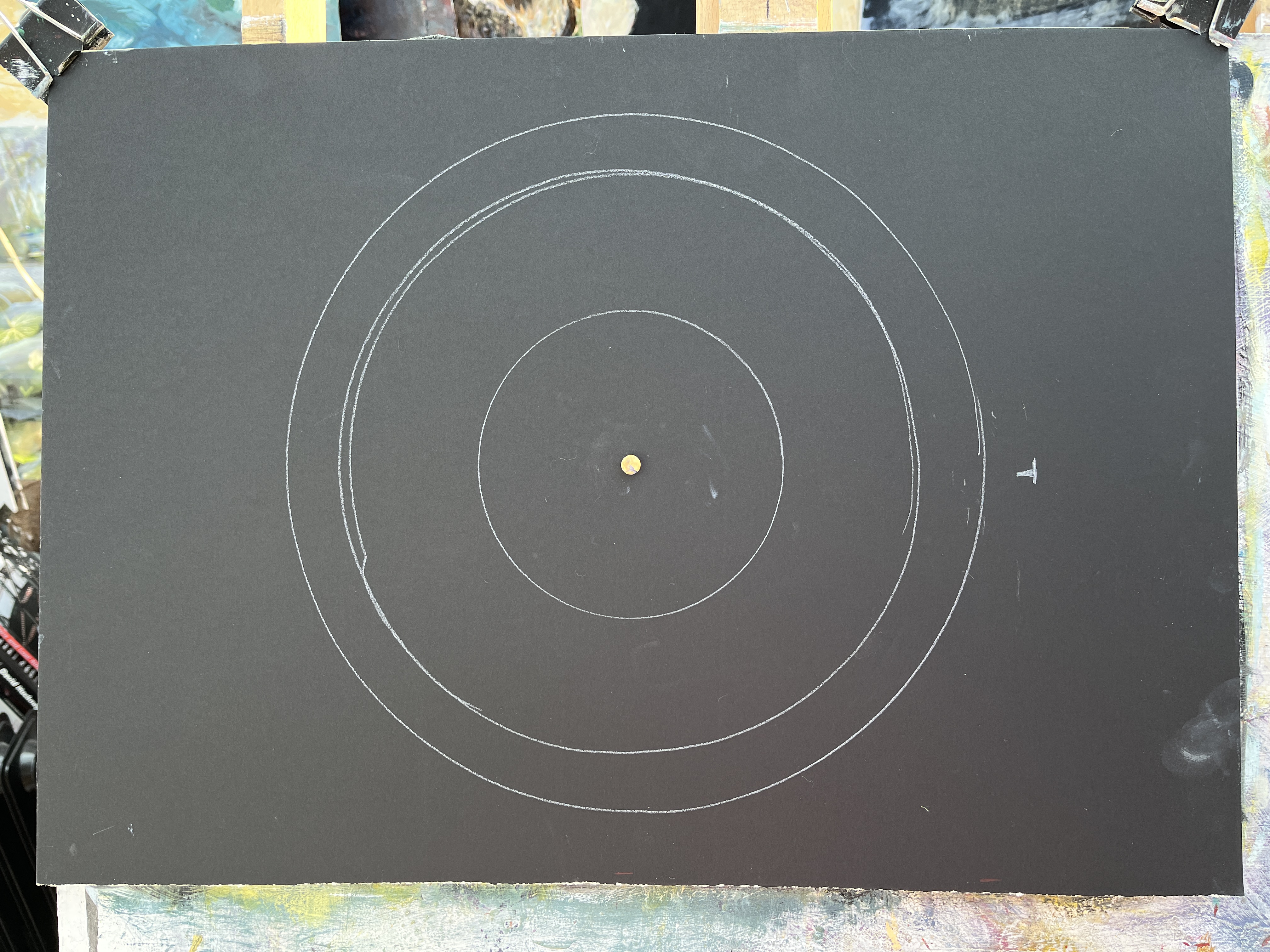
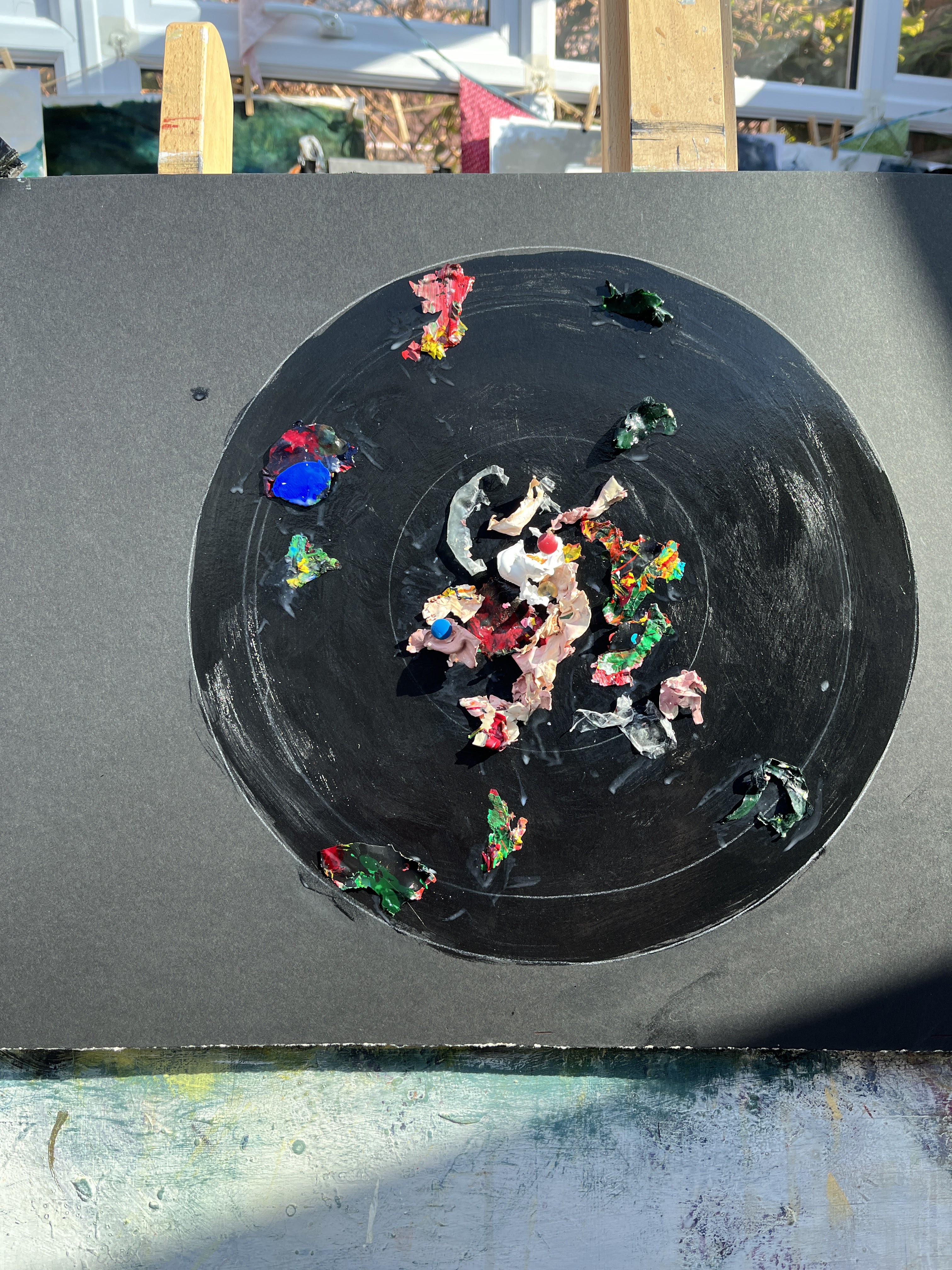


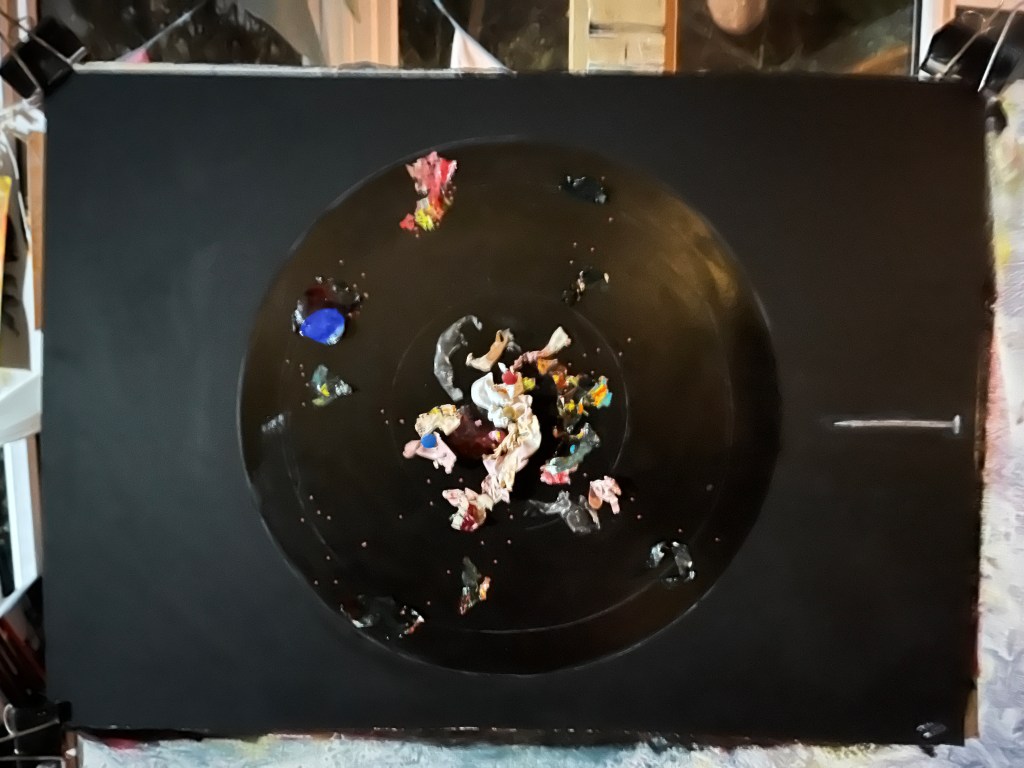
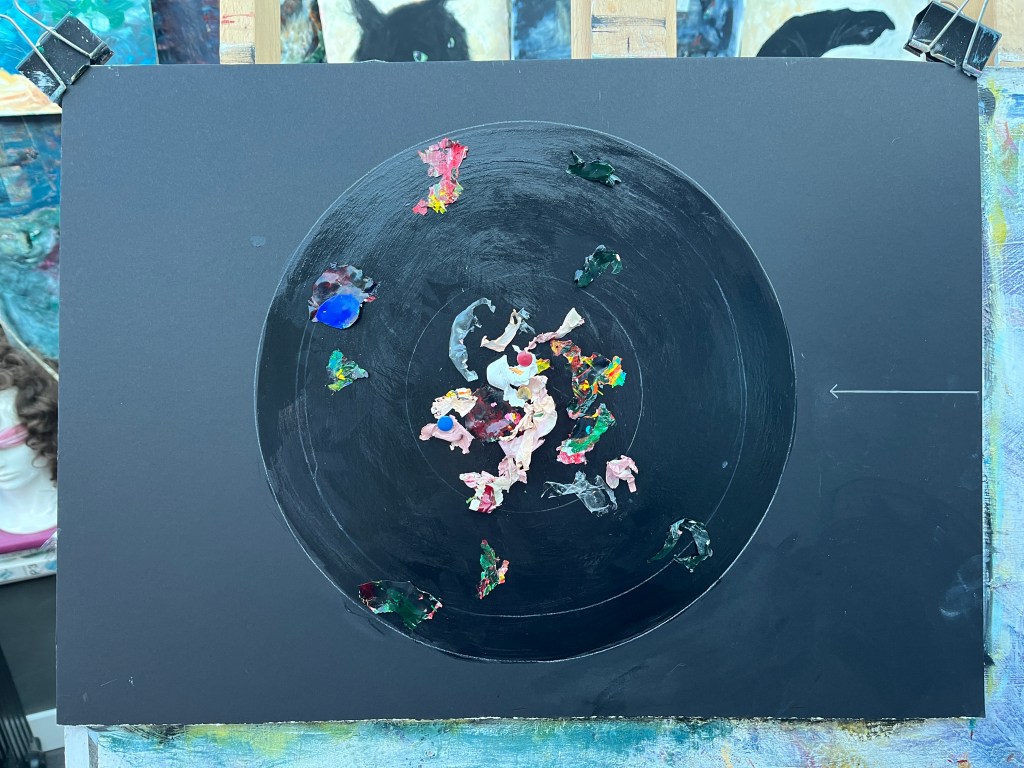

That pin gave me endless trouble which I finally solved with a pair of off-the-peg very close vision glasses, and a cut-out pin shape glued into place, painted over, and re-outlined with acrylic pen. I repainted the background with dense black oil and let it dry into the card. The circles were already painted with gloss varnish and so I just needed to tidy up the edges.
This is the proto-series, unfinished both as physical entities and as ultimate AR enabled pieces. Each piece will have its own thread as the process works towards conclusion.
SCH 2023
For a list of workshops, groups, conversations, and other activities see my dedicated page.
*The Naming of Parts is a WWI poem by Henry Reed which describes the training of recruits in the use of their rifles. Many of the parts they name are missing; the rifles will not fire; the recruits are dead before they begin. This is from the second verse:
And this is the piling swivel,
Which in your case you have not got. The branches
Hold in the gardens their silent, eloquent gestures,
Which in our case we have not got. Henry Reed (1917), via Poem Hunter https://www.poemhunter.com/poem/naming-of-parts/
Rovelli, C. (2021). Helgoland. Translated by Erica Segre and Simon Carnell. Published byAllen Lane. Also on Audible. With thanks to Clare Wilson for pointing me at it.
 Conboyhill Arts - art from stART to finish